





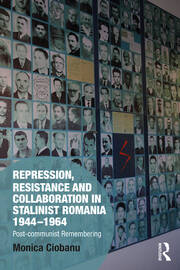
1st Edition
Repression, Resistance and Collaboration in Stalinist Romania 1944-1964 Post-communist Remembering
List of figures
Acknowledgments
Introduction
1 Repression and victimization
2 The Piteşti project: testimonies of remembering
3 Vernacular and politicized representations of the armed resistance
4 Perpetrators: indifference, denial, and delayed justice
5 Different voices: the experiences of women and their representations of repression and resistance
6 The past in the present tense: the case of the National Peasant Christian-Democratic Party and its leader Corneliu Coposu
Concluding remarks
Bibliography
Index
Biography
Monica Ciobanu holds a PhD in sociology from the Graduate Faculty of the New School for Social Research and is Professor in the Department of Criminal Justice at Plattsburgh State University of New York, USA.
'This study makes a significant contribution to post-communist and memory studies by enhancing the comparative dimension that can be brought to these subjects. As such, the book has interdisciplinary and international appeal at the level of university undergraduates and postgraduates in the fields of history and social sciences. At the same time, Dr Ciobanu performs a civic duty, one which will help to dispel the mists of distortion which hover in the minds of many over the Communist past of Romania.' - Dennis Deletant, Emeritus Professor, University College London, UK
'Based on an astonishing variety of sources, the author skilfully weaves together the insights of both memory studies and transitional justice research to provide a fascinating account of Romania’s protracted struggles to come to terms with its painful history. I highly recommend this to everyone interested in the politics of memory and identity in Central and Eastern Europe today.' - Eva-Clarita Pettai, Imre Kertész Kolleg, Friedrich-Schiller-University Jena, Germany
‘Ciobanu’s book poses difficult questions about a haunting past. The answers she provides are just as disturbing as the questions themselves – and this is the greatest merit of this work. As such, Ciobanu’s monograph constitutes a morally uneasy reading that refuses the hasty gesture of condemning the past without comprehending its complex intricacies and moral ambiguities. It is, at the same time, a theoretically reflexive and analytically lucid approach that sets the ground for a contextualized understanding of a troubled and still troubling past.’ - Mihai S. Rusu
‘ … makes an important contribution to our understanding of the processes of memory making in post-communist Romania by focusing on several agents of memory and demonstrating how a master narrative is imposed. Moreover, the book represents a valuable resource for the scholars of the memory of communism in Eastern Europe as well as for those interested in the role-played by civil society actors in the making of memory discourses.’ - Caterina Preda, Memory Studies
'The book investigates the questions that influenced public debates about the reevaluation of memory of the Communist era. In particular, Ciobanu looks at how various agents of memory, such as public intellectuals and civic organizations, contributed to these memory wars. The author shows how efforts to construct a new heroic national pantheon of anti-Communist resistance were disseminated in the public arena through a variety of channels, such as egodocuments, newspapers, journals, TV shows, documentary films, roundtables and public lectures […]. The book uses a strong theoretical framework rooted in theories about memory and transitional justice in post-authoritarian societies which are closely connected with the empirical evidence. The book has six thematically-organized chapters which detail mostly representative acts of memorialization that were at the centre of intensive memory debates in post-1989 Romania […]. Overall, this is an indispensable study of the memory wars that took place in post-1989 Romania, focusing on the Communist regime and its repressive policies and the resistance against them. Students of Romania and Eastern Europe, memory studies and transitional justice in post-1989 Europe will greatly benefit from it.' - Stefan Cristian Ionescu, Slavonic and East European Review
'M. Ciobanu analyses the diversity of the lived experience of the victims of communism (political prisoners, deportees, etc.) by emphasising how multiple identities across social classes, groups, political and religious affiliations, and generational and local divisions have shaped various processes of historical remembrance and redress (134) […]. Monica Ciobanu did an excellent job of establishing the post-communist memorialisation profile in Romania by carefully examining the competing narratives regarding the meaning of the communist past.' - Cristian Vasile, Südost-Forschungen
