




2nd Edition
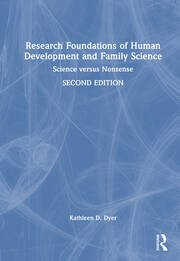
Research Foundations of Human Development and Family Science Science versus Nonsense
Part I: The Scientific Study of Human Development and Family Relationships 1. But Isn’t It Just Common Sense? How Common Sense and Personal Experience Can Lead Us Away from Truth 2. Skeptically Interrogating the Universe: Science as a Verb Part II: Falsifiability Through Study Design 3. First Comes Love, Then Comes Marriage: Orientations to Time 4. How Do Folks Think About This? Qualitative Designs to Produce Insight 5. How Often Does That Happen? Prevalence Designs to Count Things 6. Where There is Smoke, Is There Fire? Correlational Designs to Identify Relationships 7. We Just Want to Know if It Works: Experimental Designs to Establish Causation Part III: Systematic Empiricism Through Sampling and Measurement 8. It Depends on Whom You Ask: Study Subjects and Sampling Issues 9. What Do You Mean By That? Conceptualizing the Variables 10. Tell Me How It Is: Self-Report Measures 11. Just Act Natural: Observational Measures 12. More Than One Way to Cook an Egg: Other Measurement Strategies Part IV: Public Verifiability for Evidence-Based Practice 13. On Not “Doing Your Own Research”: Information and Science Literacy 14. Stealing the Good Name of Science: How Pseudoscience Fakes It 15. A Radical Force for Social Change: Advancement of Science About Human Development and Family Relationships
Biography
Kathleen D. Dyer is a professor of child and family science at the California State University, Fresno. Her research is in the areas of parenting and infant sleep, as well as critical thinking in higher education.
“Dyer’s text offers a truly unique and straightforward approach to teaching research methods in Human Development and Family Science. Rather than a heavy-handed, concept dense, how-to guide, this book is grounded in “information literacy,” which challenges students to think critically about research. Such an approach is especially useful for HDFS students, who disproportionately enter careers that require consumption over production of research. The book hits all the important facets of design, measurement, and sampling but also introduces a section on verifiability, which truly sets this book apart from others. Dyer’s text is a must have for any HDFS research methods classroom.”
Brian G. Ogolsky, PhD, Professor of Human Development and Family Studies, University of Illinois Urbana/Champaign
“Often, students new to social science research, and HDFS in particular, find the topic daunting and therefore approach it from a place of apprehension. Dr. Dyer’s book instantly puts readers at ease. She meets them where they are and tackles the very real truth of the assumption that much of HDFS is “common sense.” The way she uses relatable experiences to unpack the nuances of research methods is genius! The addition of learning activities in this second edition furthers the enduring usefulness of this text for students and instructors alike.”
Elise Radina, PhD, Professor of Family Science and Social Work, Miami University
“This is a rare methods text that students will actually want to read. Research Foundations of Human Development and Family Science is captivating from start to finish, with writing that draws readers in and keeps them invested in every chapter. What truly sets this book apart is its exceptional treatment of pseudoscience, a topic too often glossed over in research methods courses. The book equips readers with the tools to identify and sidestep the pitfalls that lead to flawed conclusions, fostering critical thinking skills that will serve them throughout their careers. The coverage of diverse methodological approaches is equally impressive, presented through compelling examples that make complex ideas feel approachable without sacrificing rigor. Students will find themselves correcting long-held misconceptions as they work through these examples, staying engaged every step of the way. Dr. Dyer has produced an extraordinary contribution to HDFS education, one that respects its readers and challenges them to think more deeply about the science underlying our understanding of families and human development. This is the methods text the field has been waiting for.”
Rodney Schmaltz, PhD, Professor of Psychology, MacEwan University
