
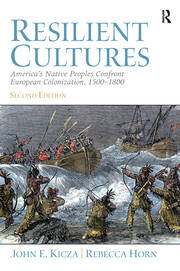
2nd Edition

Resilient Cultures America's Native Peoples Confront European Colonialization 1500-1800

By John Kicza, Rebecca Horn Copyright 2013
224 Pages
by Routledge

224 Pages
by Routledge

224 Pages
by Routledge

This book provides a comparative perspective of the impact of early European colonization on the native peoples of the Americas. It covers the character of the indigenous cultures before contact, and then addresses the impact ofand creative ways in which they adapted tothe establishment of colonies by the Spanish, Portuguese, French, Dutch, and English. Key topics: Paying attention to... Read more
List of Documents List of Illustrations Preface Chapter 1 Introduction Chapter 2 The Native Societies of the Americas Before Contact Chapter 3 The Conquests and Initial Establishment of Colonies in Latin America Chapter 4 Colonial Spanish America and Its Impact on the Sedentary Imperial Societies Chapter 5 Spanish and Portuguese Interactions with Semisedentary and Nonsedentary Peoples Chapter 6 Native Responses to Settlement in the East and Southwest in North America Chapter 7 The British and the Indians of Eastern North America Chapter 8 Enduring Connections between the New World and the Old Bibliography Index

Biography

John E. Kicza is the former department of history co-chair at Washington State University. He was as an associate dean of the college of liberal arts at WSU from 2001–2005 and served on the graduate faculty of the American studies program. He is also a former Edward R. Meyer distinguished professor. Kicza received his Ph.D. from UCLA in 1979. His fields of expertise are Latin American history and early European overseas culture contacts. His books include The Indian in Latin American History: Resistance, Resilience, and Acculturation (Scholarly Resources, 2000) and The Social History of Spanish America in the National Period (Academia Nacional de la Historia de Venezuela, 1998). His articles, chapters and entries have appeared in such journals as the William and Mary Quarterly, Hispanic American Historical Review, Renaissance Quarterly and the Latin American Research Review. He retired in June 2009.
