




1st Edition
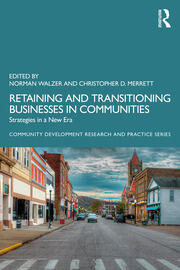
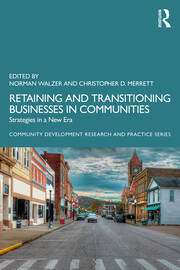
Retaining and Transitioning Businesses in Communities Strategies in a New Era
1. Retaining and Transitioning Businesses: Overview of Issues
Norman Walzer and Christopher D. Merrett
2. On the Brink of Business Transition in the U.S.: Trends, Challenges, and Opportunities
Tessa Conroy, Caroline Corona, Charles Zumbrunnen, and Steven Deller
3. Traditional Business Succession Planning: Effectiveness, Limitations, and Innovative Practices
Jarvis Tyrell Curry
4. Employee Ownership in Succession Planning
Michael Palmieri and Chris Cooper
5. Using an Employee Stock Ownership Plan for Business Transition
Corey Rosen
6. Utilizing Purpose Trusts for Rural Succession and Community Resilience
Mark C. Hand, Tiffany Vargas, and Zoe Schlag
7. Employee Ownership Trusts in the U.K.
Graeme Nuttall
8. Retaining Businesses Using Community-Supported Enterprises
Norman Walzer and Ben Doyle
9. Creating Rural Worker Cooperatives in Iowa
Stacy Mullinex
10. Buying Private Businesses in a Single Vertical: A New Approach to Rural Investment
Dawn McGee, Kiah Hochstetler, and Michael Braun
11. Capital-Driven Business Succession: Main Street Approach
Todd Barman and Errin Welty
Biography
Norman Walzer is professor of economics emeritus and founding director of the Illinois Institute for Rural Affairs, at Western Illinois University. He also is past president of the Community Development Society.
Christopher D. Merrett is dean for Innovation and Economic Development, director of the Illinois Institute for Rural Affairs, and program chair for the Master of Arts in Community and Economic Development at Western Illinois University.
"One of the most critical challenges facing both rural and urban communities is the retention and transitioning of local businesses. This book is incredibly timely as it addresses these conditions in a post-pandemic world that has significantly reframed how businesses can operate, despite geography or other conditions that previously would have threatened retention and transition. In response to these unprecedented conditions, Norman Walzer and Christopher Merrett provide invaluable insights into the opportunities, challenges, critical needs, and careful considerations needed to revitalize local businesses and economies in a variety of settings. It is a must-read to help business owners, policy makers, practitioners, and others make businesses and communities stronger."
Mark Brennan, Professor of Community Development and UNESCO Chair for Community and Leadership Development, Penn State University
"With nearly 3 million business owners approaching retirement causing the largest transfer of wealth ever in the United States, this book couldn't be more timely. Retiring owners must consider alternative ownership approaches (including employee ownership) and the editors have gathered a 'who's who' of experts that provide incredibly easy to understand, yet in-depth, information on all forms of employee ownership and other alternatives to a traditional third-party sale. It is a must read for business owners, advisors, and community leaders concerned with keeping good jobs local and rewarding the employees who have helped produce the profits."
Steve Storkan, Executive Director, Employee Ownership Expansion Network
"Companies usually are owned by private individuals, or by external shareholders. However, they can be owned by their customers, employees, local communities, or other stakeholders (such as with producer co-operatives), or by some combination of these stakeholders. Such alternative, or 'mutual' ownership, is sometimes criticised as being unable to scale up, particularly globally, as easily as privately and shareholder owned companies can. This book focusses on what is good especially in rural areas and small towns. In these cases, it is a positive advantage if businesses remain relatively small scale and locally rooted. Thus, for these areas, when it comes to business succession, selling the company to its employees or customers makes perfect sense."
Jonathon Mitchie, Director, Oxford Centre on Mutual & Co-owned Business and President, Kellogg College, Oxford
"Retaining and Transitioning Businesses in Communities is an insightful, must-read exploration of how employee ownership models—ESOPs, EOTs, worker cooperatives, and community-supported enterprises—can safeguard businesses during ownership transitions. The focus on rural and smaller communities demonstrates how these strategies not only preserve local economies but also foster resilience and long-term sustainability. This timely work is a powerful resource for those passionate about building inclusive, transformative businesses that empower communities and reshape the future of ownership. An essential addition to the conversation on the power of employee ownership."
James de le Vingne, CEO, UK Employee Ownership Association
"Retiring small business owners with no family successors are selling to their workers, securing family wealth and creating a huge employee share ownership sector in the US economy. What a positive development: this is the best book to read about it."
Joseph R. Blasi, J. Robert Beyster Distinguished Professor and Director, Institute for the Study of Employee Ownership and Profit Sharing, Rutgers University
