



1st Edition
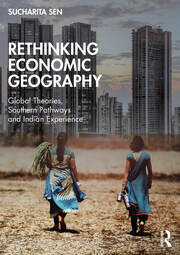
Rethinking Economic Geography Global Theories, Southern Pathways and Indian Experience
PART 1: Intellectual Histories in Economic Geography: Global Lineages and Southern Pathways
Chapter 1: Doing Economic Geography: Interdisciplinarity and Spatial Commitments
1.1 Understanding Geography as a Discipline
1.2 Crossroads of Economics and Geography: Conflict and Convergence
1.2.1 Fault Lines between Economics and Geography
1.2.2 Economics and Geography: Synergies and Mutual Enrichment
1.3 Defining Economic Geography: Evolution of Questions
1.4 Expanding Economic Geography: Critical and Ethical Turns
1.5 Seeing the Economy Geographically
1.6 Reading the Indian Economy Geographically
1.6.1 Diversity of Economic Forms and Spatial Scales
1.6.2 Contradictions of Growth and Inequality
1.6.3 Historical Embeddedness of Spatial Inequality
1.6.4 Situated Interdisciplinarity and Knowledge Production
Research Ideas and Discussion Points
Chapter 2: Global Trajectories in Economic Geography: From Classical Foundations to Contemporary Debates
2.1 Introduction
2.2 Colonial and Early Disciplinary Period (1925–1947)
2.3 The Age of Planning: Reconstruction and Developmentalism
2.3.1 Quantitative Revolution and Spatial Science
2.3.1.1 Global North: Reconstruction, Welfare States, and Technocratic Spatial Science
2.3.1.2 Global South: Nation-Building, Equity, and Divergent Legacies of Colonialism
2.3.1.3 Methodological Parallels, Divergent Purposes
2.3.2 The Radical Turn: Political Economy and the Critique of Spatial Science
2.4 Globalisation, Neoliberal Restructuring and the Critical Turn (1991–2025)
2.4.1 From Flexible Specialisation to Flexible Accumulation
2.4.2 Neoliberalism, Multinational Corporations, and Global Production Networks
2.4.3 Digital Capitalism and the Politics of Time-Space Compression
2.4.4 Financialisation and the Re-spatialisation of Capital
2.4.5 Feminist Economic Geography and the Politics of Difference
2.4.6 South-South Geographies and Multipolar Orders
2.5 Negotiating Trajectories: The Evolving Agenda of Economic Geography
Research Ideas and Discussion Points
Chapter 3: Mapping Space and Economy: A Century of Economic Geography in India
3.1 Introduction
3.2 Pre-Independence Colonial Period (1925–1947)
3.2.1 Foundations of Geography in Colonial India
3.2.2 Colonial Scholarly Influences
3.2.3 State of the Discipline by 1947
3.2.4 The Colonial Spatial Legacy
3.3 Period of Dirigisme: The Closed Economy Era (1948–1990)
3.3.1 National Development Agenda
3.3.2 Spatial Structuring of Development
3.3.3 Research Themes, Methods, and the Limits of the Planning Framework
3.4 Responding to the Opening of the Economy
3.4.1 Economic Liberalisation and Spatial Restructuring
3.4.2 New Empirical Concerns
3.4.3 Theoretical and Methodological Developments
3.5 Mapping Disciplinary Trends: Evidence from the Indian Geographical Journal (1926–2025)
3.5.1 Rationale and Scope
3.5.2 Method and Limitations
3.5.3 Thematic Trends in Economic Geography
3.5.4 Shifts Across Subfields
3.5.5 The Archive and its Absences
3.6 Conclusion: Transitions and Analytical Directions in Indian Economic Geography
Research Ideas and Discussion Points
Chapter 4: Rethinking Space, Place, Time and Power
4.1 Introduction
4.2 Conceptualising Space in Economic Geography
4.3 The Place of “Place” in Economic Geography
4.4 Scale and the Politics of Spatial Organisation
4.5 Space-Place Entanglements: Contradictions and Complexity
4.6 Globalisation and the Co-existence of Space and Place
4.7 Space as a Medium of Power
4.8 Time, Space, Power and the Production of Uneven Geographies
4.9 Rethinking Space, Place, Time, and Power in an Uneven World
Research Ideas and Discussion Points
Chapter 5: Frames and Lenses: Analytical Traditions in Economic Geography
5.1 Introduction
5.2 Descriptive Frames of Economic Geography
5.2.1 The Regional Frame: Description, Synthesis, and Areal Differentiation
5.2.2 The Systematic Frame: Commercial Geography and the Geography of Empire
5.3 The Neo-Classical Economic Frame: From Location Theory to New Economic Geography
5.3.1 The Analytical Turn: Location, Cost, and Spatial Order
5.3.2 What the Frame Makes Possible
5.3.3 What the Frame Sees, and What It Does Not
5.3.4 The Frame in Context
5.4 Political Economic Geography: Space, Power, and the Production of Uneven Development
5.4.1 From Location to Production of Space
5.4.2 Uneven Development and the Spatial Dynamics of Capital
5.4.3 Extending the Structural Frame
5.4.4 The Frame in Context: India and the Production of Space
5.4.5 From Explanation to Critique
5.5 Post-Structural Frames: Space, Meaning, and Lived Economies
5.5.1 From Structure to Experience: Reworking Space, Place, and Method
5.5.2 Place as Lived, Represented, and Contested
5.5.3 Feminist and Cultural Economic Geographies: Difference, Embodiment, and Social Reproduction
5.5.4 Rethinking the Economy: Beyond Capitalocentric and Formal Models
5.5.5 What This Frame Makes Visible, and Its Limits
5.6 Bringing Frames and Lenses Together: Structure, Difference, and Historical Process
Research Ideas and Discussion Points
PART 2: Contemporary Economic Geography of India
Chapter 6: Producing the Nation-Space: Colonialism, Developmentalism, and Liberalisation in India’s Economic Geography
6.1 Producing the Nation-Space: A Conceptual Frame
6.2 The Colonial Period: Producing India’s Spatial Economy (1757–1947)
6.2.1 The Logic of Colonial Spatial Reorganization
6.2.2 Core, Periphery, and the Making of Geographical Fragments
6.2.3 The Spatial Inheritance of Colonialism
6.3 The Developmental State and Its Spatial Limits
6.3.1 The Promise of the Postcolonial Nation-Space
6.3.2 Passive Revolution and the Limits of Spatial Transformation
6.3.3 The Spatial Outcomes of Dirigiste Development
6.3.4 Fiscal Federalism as Spatial Strategy
6.3.5 The Crisis of the Developmental State and Its Spatial Legacy
6.4 The Neoliberal Era: Fragments, Circuits, and the Rearticulation of the Nation-Space
6.4.1 The Political Economy of Liberalisation: ‘Elite Revolt’ and the Opening of the Economy
6.4.2 Selective Integration: The Spatial Geography of Post-1991 Growth
6.4.3 Governing the Fragments: Welfare, Biometrics, and Political Society
6.4.4 The Ideological Rearticulation of the Nation-Space
6.4.5 Competitive Federalism and Spatial Inequality
6.4.6 Spatial Legacies: The Persistence and Deepening of the Fragments
6.5 Conclusion: Nation-Space, Fragments, and the Limits of Inclusion
Research Ideas and Discussion Points
Chapter 7: Global Production Order and India’s Economic Geography
7.1 Introduction
7.2 Partial Globalization: The Near-Perfect Mobility of Capital and the Constrained Movement of Labour
7.3 Production Regimes in the Post-War Global North
7.4 The Transition from Fordism to Post-Fordism
7.4.1 Productivity Slowdown and the Limits of the Fordist Settlement
7.4.2 Saturation and Fragmentation of Home Markets
7.4.3 Competition from Industrialising Economies and the Search for New Labour
7.4.4 Technological Change and the Enabling of Flexible Production
7.5 Production Geographies in the Post-Fordist Era
7.5.1 Features of Post-Fordist Production
7.5.2 Flexible Accumulation as a Political Process
7.6 Multinational Corporations, the New International Division of Labour, and Global Value Chains
7.6.1 MNC Hierarchies and the Spatial Organisation of Production
7.6.2 The New International Division of Labour
7.6.3 Global Value Chains and Functional Lock-In
7.7 Neoliberal Processes and Implications for India’s Economic Geography
Research Ideas and Discussion Points
Chapter 8: Neoliberal Spatialities: India’s Emerging Production Landscapes and the Agrarian Question
8.1 Neoliberal Spatialities: A Framework for the Chapter
8.2 Production Enclaves and Spaces of Exception: SEZs, Industrial Corridors, and the Logic of Enclave Accumulation
8.2.1 The Enclave Model: Nature and Origins
8.2.2 The SEZ Policy: Stated Intentions and the Language of Development
8.2.3 Spatial Concentration, Exclusion, and Disconnected Growth
8.3 The Rural Buffer and the Urban Accumulator: Unequal Spatial Burdens in India’s Economy
8.4 Regional Divergences and Sectoral Structures in India’s Political Economic Geography
8.5 Seeing it from the Margin: Spatialities of Agrarian Distress and its Roots
8.5.1 Understanding the Causes and Persistence of Agrarian Distress in India
8.5.2 Regional Patterns of Agrarian Distress
8.5.3 Public and Private Investment in Agriculture: Structural Divergence and Spatial Implications
8.5.4 The Politics of Numbers
8.6 Conclusion
Research Ideas and Discussion Points
Chapter 9: Fragmented Work: Caste, Gender, and Labour Geographies in Neoliberal India
9.1 Introduction
9.2 Class, Caste, Gender, and the Spatial Logic of Labour Exploitation under Neoliberal Capitalism
9.2.1 Class and the Reserve Army under Neoliberal Accumulation
9.2.2 Racial Capitalism and Its Relevance for India
9.2.3 Caste as a Mechanism of Neoliberal Accumulation
9.2.4 Intersections: Gender, Caste, and the Socio-Spatial Segmentation of Labour
9.3 Mechanisms of Flexible Accumulation: Contractualization, Subcontracting, and the Spatial Fragmentation of Work
9.3.1 Contractualization: Dispersing Accountability, Concentrating Vulnerability
9.3.2 Subcontracting, Outsourcing, and the Spatial Hierarchy of Production
9.4 Urban Labour Geographies: Fragmentation, Exclusion, and the Bifurcated City
9.4.1 Employment in Urban India
9.4.2 Spatial Differentiation of Urban Employment
9.4.3 Urban Unemployment: Trends and Spatial Patterns
9.4.4 Urban Labour Spaces: Transience, Exclusion, and the Politics of Illegibility
9.5 Rural Labour, Agrarian Crisis, and the Political Economy of Dispossession
9.5.1 Employment and Unemployment Trends in Rural India
9.5.2 Labouring Lives: Caste, Gender, and the Uneven Geography of Agrarian Work
9.6 Conclusion: The Spatial Logic of Labour Under Neoliberal Capitalism
Research Ideas and Discussion Points
Chapter 10: Trade, Value, and Labour in India’s Global Integration
10.1 Trade and the Post-Fordist Order
10.2 Volume, Composition, and the Structure of India’s Trade since 1991
10.2.1 The Anatomy of a Trade Deficit
10.2.2 The Changing Composition of Trade
10.3 Value, Labour, and the Glass Ceiling of Global Integration
10.3.1 Intra-Industry Trade as the Signature of Fragmented Production
10.3.2 The Employment Consequence: Scale Without Jobs
10.3.3 MNCs, FDI, and the Enclave Form of Value Capture
10.3.4 The Glass Ceiling as Structural Condition
10.4 Volume, Value, and the Limits of Integration Through Trade
10.5 Concluding Thoughts: Part 2 in Retrospect
Research Ideas and Discussion Points
Biography
Sucharita Sen is Professor, Centre for the Study of Regional Development, Jawaharlal Nehru University. Her research spans labour geographies, agrarian change, gender, water, and peri-urban commons. She co-authored Land Resources (2004), co-edited Marginalization in Globalizing Delhi (2016), with articles in leading national and international journals.
