




1st Edition
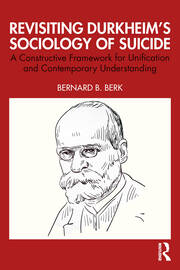
Revisiting Durkheim’s Sociology of Suicide A Constructive Framework for Unification and Contemporary Understanding
1 Introduction and Durkheim’s framework 2 Durkheim’s theory: Establishing suicide as a social act and the identification of the forces causing suicide and their origins 3 How the social forces cause distinctive types of suicide 4 Macro-micro relations and individual acts of suicide 5 Critical evaluation of Durkheim’s study and theory of suicide 6 Resolving the ambiguities and contradictions in Durkheim’s theory 7 Conclusion
Biography
Bernard B. Berk is Professor Emeritus of Sociology at California State University, Los Angeles. He has taught at a wide range of universities including UCLA, UCSB, University of New Hampshire, CSULA, CSUN, and CSUSD. His areas of specialty include theory, deviance, criminology, penology, and mental illness. He has received numerous teaching awards.
This book offers a useful survey of Durkheim’s theory of suicide from the perspective of present day sociology. It is an introductory work that disentangles layers of interpretative threads around this key text, and provides a notable framework for understanding the relevance of Durkeim’s foundational text for today.
Stephen Turner, Distinguished University Professor, University of South Florida
This is one of the most interesting books on Durkheim in recent years, let alone one focused on Durkheim’s foundational text. The book outlines Durkheim’s categorization of “types of suicide” very clearly, and the underlying theory of socio-cultural integration of societies. It not only helps sort through the layers of interpretation around Durkheim’s text that have built over the years in a helpful way, but introduces its own, and new, critique of Durkheim’s analysis; and moreover, it offers some ways to clarify Durkheim’s meanings on some of the ambiguous statements that he made in Suicide. It offers something new for today’s readers and students, and shows how this pivotal, founding sociology text is still relevant to today’s society and our understanding of it.
Jonathan H. Turner, University Professor of Sociology, University of California, Santa Barbara
