





List of tables
Acknowledgements
Introduction
1. Why a book on Ricardo on money?
Revaluation
Rehabilitation
Completeness
Relevance
2. An evolution in Ricardo’s theory of money
The relation with the theory of value and distribution
Ricardo’s mature theory of money in brief
3. The content of the book: history, theory, policy
Part I. History
Part II. Theory
Part III. Policy
4. Two hundred years after
PART I History
1 The historical context
1.1 The English monetary system at the time of Ricardo
Currency
Banking
1.2 International monetary relations in Europe: London, Paris, Hamburg
1.3 From Hume to the Bullionist Controversy
David Hume and James Steuart
The Bullionist Controversy
A central question: the role of note-issuing in monetary disorder
1.4 The first round of the Bullionist Controversy (1797‒1803)
The search for analytical foundations
Thornton’s Paper Credit of Great Britain
Appendix 1: Ricardo on the bullion and foreign exchange markets
1. Ricardo contradicts Bosanquet on the rise of gold on the Continent
2. Ricardo contradicts Vansittart on the state of the exchange with Hamburg in 1760
2 Ricardo’s battles on currency and banks
2.1 Ricardo and the Bullion Controversy (1809‒1811)
The second round of the Bullionist Controversy
Ricardo’s positions
2.2 Ricardo and the resumption of convertibility (1816‒1823)
The third round of the Bullionist Controversy
Ricardo’s two plans
2.3 Conclusion: the legacy of Ricardo’s monetary battles
Appendix 2: Attacks and weapons
1. Attacks: critical opinions on Ricardo
2. Weapons:
Biography
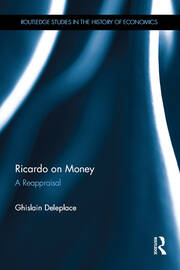
Ghislain Deleplace is Emeritus Professor of Economics at University Paris 8 at Saint-Denis, France. His fields of research are the history of monetary thought (Steuart, Ricardo, Marx, Keynes, Sraffa), the history of the international monetary system (sixteenth century, nineteenth century), and the Post-Keynesian theory of money.
