




1st Edition
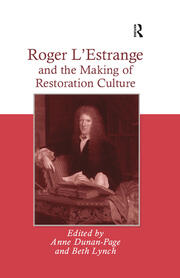
Roger L'Estrange and the Making of Restoration Culture
264 Pages
by
Routledge
264 Pages
by
Routledge
Also available as eBook on:
Roger L'Estrange (1616-1704) was one of the most remarkable, significant and colourful figures in seventeenth-century England. Whilst there has been regular, if often cursory, scholarly interest in his activities as Licenser and Stuart apologist, this is the first sustained book-length study of the man for almost a century. L'Estrange's engagement on the Royalist side during the Civil war, and... Read more
Contents: Introduction, Anne Dunan-Page and Beth Lynch; Rhetoricating and identity in L'Estrange's early career, 1659-1662, Beth Lynch; L'Estrange's Milton, Nicholas von Maltzahn; L'Estrange, Marvell and the Directions to a Painter: the evidence of Bodleian Library, MS Gough London 14, Martin Dzelzainis; Roger L'Estrange's Observator and the exorcism of the plot, Mark Goldie; 'Tales and romantick stories': 'Impostures', trustworthiness, and the credibility of information in the late 17th century, Peter Hinds; Roger L'Estrange and the Huguenots: continental Protestantism and the Church of England, Anne Dunan-Page; 'The art of schooling mankind': the uses of the fable in Sir Roger L'Estrange's Aesop's Fables (1692), Line Cottegnies; 'My fiddle is a bass viol': music in the life of Roger L'Estrange, Andrew Ashbee; L'Estrange, Joyce and the dictates of typography, Harold Love; The works of Roger L'Estrange: an annotated bibliography, Geoff Kemp; Select bibliography of secondary sources; Index.
Biography
Anne Dunan-Page is a Lecturer at Université Paul Valéry, Montpellier III, France. Beth Lynch is Director of Studies and Lecturer in the Department of English, Newnham College, Cambridge, UK.
’This is the first sustained, book-length study of Roger L'Estrange, one of the most significant and colourful figures in the 17th century.’ Cahiers Elisabéthains ’... most students of the Restoration will find much to interest them in Roger L’Estrange and the Making of Restoration Culture.’ Sixteenth Century Journal
