





1st Edition
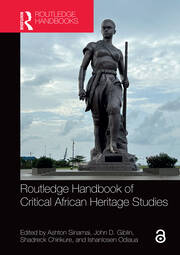
Routledge Handbook of Critical African Heritage Studies
Foreword: An African Critical Heritage Studies?
Webber Ndoro
Chapter 1: Introducing African Critical Heritage Studies
John D. Giblin, Ashton Sinamai, Shadreck Chirikure, and Ishanlosen Odiaua
Part 1: Useable Pasts, Justice and Society
Chapter 2: Part Introduction: Useable Pasts, Justice and Society
Shadreck Chirikure, John D. Giblin, Ashton Sinamai and Ishanlosen Odiaua
Chapter 3: Useable Heritage and West Africa: Liberation for the People
Caleb Adebayo Folorunso
Chapter 4: Post-Conflict Memory and Heritage: South Sudan and Beyond
Zoe Cormack
Chapter 5: Heritage the Use of the Past in Eastern Africa
John D. Giblin
Chapter 6: Heritage, Society, and Justice in Central Africa
Annalisa Bolin
Chapter 7: Heritage and Social Justice in Southern Africa: Rethinking Spaces of Community Involvement in Heritage Management
Vuyiswa Lupuwana
Chapter 8: Part Introduction: Heritages of Slavery
Ishanlosen Odiaua, John D. Giblin, Ashton Sinamai, and Shadreck Chirikure
Chapter 9: Narrating the Slave Trade and Slavery Heritage in West Africa and its Diaspora
Rachel Engmann
Chapter 10: Slavery Tourism in Eastern Africa
Herman Kiriama
Chapter 11: Slavery Legacy in the Congo Basin
Noemie Arazi, Igor Matonda and Alexandre Livingstone Smith
Chapter 12: African Diaspora Heritage in the Americas
Christopher Fennell
Part 3: African Objects and the Global Museum-Scape
Chapter 13: Part Introduction: African Objects and the Global Museum-Scape
John D. Giblin, Ashton Sinamai, Shadreck Chirikure, and Ishanlosen Odiaua
Chapter 14: North Africa's Dispersed Heritage
Alice Stevenson
Chapter 15: Collecting (East) Africa in the Age of Empire
Sarah Longair
Chapter 16: Restitution, Repatriation and Reparation: Current Debate
JC Niala
Chapter 17: The Ethnicization of Namibian Human Remains from Germany: ‘Cutting across tribal affiliation’
Vilho Amukwaya Shigwedha
Part 4: Perceptions of an African Cultural Landscape
Chapter 18: Part Introduction: Perceptions of an African Cultural Landscape
Ashton Sinamai, Shadreck Chirikure, John D. Giblin and Ishanlosen Odiaua
Chapter 19: The Decolonization of Monumental Landscapes and Heritage Policies in Africa
Albino Jopela and Rim Kelouaze
Chapter 20: Tradition, Power and Landscape: West African Royal Palaces
Ishanlosen Odiaua and Salim Bashir
Chapter 21: Maritime Heritage in Eastern and Southern Africa
Stephanie Wynne-Jones, Caesr Bita and Narriman Jiddawi
Chapter 22: Rock Art and the African Landscape: Explorations of Paintings from Matopo Hills, Zimbabwe and Chongoni Hills, Malaŵi
Siyakha Mguni and Benjamin Smith
Chapter 23: Biocultural Heritage: Definitions, Applications and African Case Studies
Paul J. Lane and Benny Q. Shen
Part 5: Global Heritage Systems and the Management of Heritage in Africa
Chapter 24: Part Introduction: Global Heritage Systems and the Management of Heritage in Africa
Ashton Sinamai, Ishanlosen Odiaua, John D. Giblin and Shadreck Chirikure
Chapter 25: Excluding Communities, Liberation Heritage and Managing Conflict: Tracing ‘Westernised’ Heritage Practices in Southern Africa
Ndlovu Ndukuyakhe
Chapter 26: African Customary Law and the Impact of Non-African Cultural Heritage Legislation in Africa
Thomas Panganayi Thondhlana
Chapter 27: World Heritage for Sustainable Development in Africa
Sophia Labadi
Chapter 28: The Sustainability Question in Heritage Tourism Development in Africa
Bailey Ashton Adie, Emmanuel Akwasi Adu-Ampong, and Noel Biseko Lwoga
Chapter 29: African Oral Traditions as Heritage and UNESCO’s Intangible List
Herbert Chimhundu
Part 6: Decolonising African Heritage
Chapter 30: Part Introduction: Decolonising African Heritage
Shadreck Chirikure, John D. Giblin, Ishanlosen Odiaua and Ashton Sinamai
Chapter 31: Coloniality and Decoloniality of Heritage Institutions in West Africa
J. Kelechi Ugwuanyi
Chapter 32: Decolonising the Dead or Decolonising Death in Southern Africa? Some Hesitations
Joost Fontein
Chapter 33: Decolonising the Academy: Heritage, #RhodesMustFall and the University of Cape Town? (TBC)
Nick Shepherd
Chapter 34: What British Museums Mean When They Talk About Decolonising Their African Collections, And What They Don’t
Johanna Zetterström-Sharp
Chapter 35: How to Decolonise a Museum: Lessons from the African Continent
Annie E. Coombes
Biography
Ashton Sinamai is an archaeologist with experience from Zimbabwe, Namibia, United Kingdom and Australia. He has a PhD in Cultural Heritage and Museum Studies from Deakin University and currently works as a Heritage Consultant for Ecology and Heritage Partners. Previously he has worked as an archaeologist at Great Zimbabwe, Chief Curator at the National Museum of Namibia and as lecturer at the Midlands State University, Zimbabwe.
John Daniel Giblin is Keeper of Global Arts, Cultures and Design at National Museums Scotland. He was previously Head of Africa Section at the British Museum and holds an honorary position in archaeology at University College London. His current research focuses on museum colonial histories and legacies and participatory practice in the UK and his previous research focused on critical studies of post-conflict heritage and archaeology in eastern and central Africa.
Shadreck Chirikure is Edward Hall Professor of Archaeological Science and Director of the Research Laboratory for Archaeology and the History of Art in the University of Oxford. He applies methods from the sciences to understand materials as a step towards learning about the people that produced them and to conserve heritage.
Ishanlosen Odiaua is a Senior Social Development Specialist at the World Bank. She holds a doctorate degree in Art history (architectural conservation) and is President of the ICOMOS Advisory Committee.
This volume is a tour de force of heritage studies from Africa. It does not shy away from tackling critical issues from difficult heritage to the legacies of colonialism in Africa. The editors and authors have traversed the continent to bring to the fore the multi-layered nature of African heritage and the complexity of managing it. The volume is a timely critique of the use of the past through time and proffers caution on the potential abuse of heritage resources in the present and future. The volume enriches current debates on Africa’s heritage as the continent grapples with its positionality in the global world order. With the current state of conflicts globally, can African heritage contribute to sustainable peace? This volume offers a ray of hope. I recommend it to all beyond students of African studies.
Alinah K. Segobye, Dean of Human Sciences at the Namibia University of Science and Technology and an elected fellow of the African Academy of Sciences.
The book is a very important and welcome addition to the ever-growing literature on topical issues relating to different concerns with Africa’s diverse heritage from various perspectives. Written by leading heritage practitioners and scholars from the continent and abroad, the thirty-five chapters that make up this book cover a wide range of topics and is a must read for instructors, students as well as the lay reader. The different chapters cover a wide range of topics that include the significance attached to cultural objects, sites and monuments, museums, and museology in Africa as well as the legal frameworks for heritage management and the ongoing debates on the decolonisation agenda. This wide coverage is such that the book offers something for everyone interested in Africa’s cultural heritage, its use (and abuse), its management, its role in the present and sustainable management for future generations.
Gilbert Pwiti, Professor of Heritage Studies, School of Humanities, Sol Plaatje University, Kimberley, South Africa
