




1st Edition
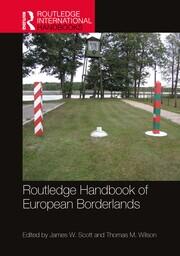
Routledge Handbook of European Borderlands
1. Introduction: European Borderlands as Arenas, Platforms and Mirrors of Transformation
James W. Scott and Thomas M. Wilson
Section One: Borderlands of (In)security and Control
2. ‘Crisis’ in the Channel? Practices of Securitization and Epistemic Borderwork in the British/European Borderlands
Thom Tyerman and Nick Vaughan-Williams
3. Borderland Geopolitics: The Unsettledness of European Borders
Jaume Castan Pinos and Steen Bo Frandsen
4. Borderlands into Bloodlands, The Ukrainian-Russian Border and the End of the “Post-Soviet”
Tatiana Zhurzhenko
5. People as Weapons. Securitization, Moral Arguments and Nature on the EU-Belarus Border
Agnieszka Halemba
6. European Border Bystanders: More than Human and more than European Border Stories
Sarah Green
7. The Impact of the Covid-19 Crisis on Cross-Border Cooperation in Europe
Elżbieta Opiłowska and Florian Weber
Section Two: Creativity, Cooperation and Resilience
8. The Finnish-Swedish Borderland as a Resilient Space of Cross-Border Relations
Eeva-Kaisa Prokkola
9. The Greater Region, or the Paradox of Cross-border Integration
Christophe Sohn
10. The Galicia-Northern Portugal Euroregion as a Cooperative Borderland
Juan-M. Trillo-Santamaría, Valerià Paül and Roberto Vila-Lage
11. Border Twin Cities in Europe: An Outline of the Phenomenon and Its Study
Ekaterina Mikhailova
12. Collaborative Borderscaping; Using the Border as a Resource for Cross-Border Spatial Design
Vincent Pijnenburg and Henk van Houtum
13. Bordering and Cross-Bordering at the Italy-France Frontier
Raffaella Coletti
Section Three: Mashing and Clashing Sovereignties and Identities
14. Mashing and Clashing Sovereignties: How Brexit Was Conceived in the Irish Borderlands
Katy Hayward and Milena Komarova
15. Banal and Instrumental Brexitism in the Northern Ireland Borderlands
Thomas M. Wilson
16. Imbricated Borderlands in the European Governance of Refugeehood
Olga Demetriou
17. Populism and Borderlands: The Use of Spatial Objects in the Name of the People
Christian Lamour
18. From “Borderless World” to “Borders are Everywhere”. The Boundary Work of Refugees and Volunteers in Denmark after the “Return Turn”
Marie Sandberg
19. The Danish-German Borderland
Martin Klatt
Section Four: European Borderlands in (Post)Globalization
20. Hungary as a Borderland Nation
Péter Balogh
21. Borderlands Geo(ethno)politics at the EU’s External Frontiers: The Case of Transcarpathia
James W. Scott
22. Turkey as a European Borderland: Syrian Displacement, Disaster and Security
Şule Can
23. Territorial Security Walls, Sovereignty, and the Reconstruction of the Nation-State
Ramazan Aras and Ibrahim Emre Yanik
24. Whose Border, Which Crisis? Illiberalism and the (Re)nationalization of Poland’s Eastern Frontier, 2015-2022
Karolina Follis
25. Transboundary Nature Protection and National Parks in European Borderlands
Marek Więckowski
26. The Shifting Significance of the Finnish-Russian Borderland
Jussi P. Laine
Biography
James W. Scott is Professor of Regional and Border Studies at the Karelian Institute, University of Eastern Finland, Finland.
Thomas M. Wilson is Professor of Anthropology at Binghamton University, State University of New York, USA.
