





1st Edition
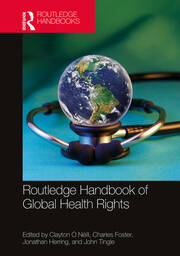
Routledge Handbook of Global Health Rights
Table of Contents
Index
Part A
Chapter 1: Clayton Ó Néill, An introduction to health rights as they apply in a global landscape
Chapter 2: Charles Foster, Universal Declaration of Human Rights Part I: Articles 1, 2 3, 5 and 6
Chapter 3: Jonathan Herring, Universal Declaration of Human Rights Part II: Articles 7, 12, 16, 18, 19 and 25
Chapter 4: Clayton Ó Néill, A global right to health amid global health emergencies
Chapter 5: Thana de Campos-Rudinsky, Global Health Rights in the Inter-American Court of Human Rights: On the Doctrine of the Minimum Core Obligations and a Co-Responsibility to Care
Part B
Beginning of life and children
Chapter 6: Zahara Nampewo, Assisted Reproductive Technologies in Uganda: Law and Practice
Chapter 7: Clayton Ó Néill, Abortion and conscience: a crossroads for Northern Ireland
Chapter 8: Santa Slokenberga, The standard of care and implications for paediatric decision-making: the Swedish viewpoint
Middle of Life
Chapter 9: Edward Lui, The right to health in Hong King: incorporation, implementation and balancing
Chapter 10: Sushant Chandra, ‘Dignity’ in the adjudication of health rights in India
Chapter 11: Cheluchi Onyemelukwe, Universal health coverage and the right to health in Nigeria
Chapter 12: Naomi N Njuguna, Realising the right to health in Kenya: connecting health governance outcomes to patient safety perspectives
Chapter 13: John Tingle, Developing an intrinsic patient safety culture in health systems: the NHS experience
Chapter 14: Stephen King, Clinical Negligence Litigation Procedure, Policy and Practice in England: the product of a legal cycle rather than an application of a right to health?
Chapter 15: Helen Hughes, Patient Safety and Human Rights
Chapter 16: Jean V McHale and Elizabeth Speakman, Fundamental rights to health care and charging overseas visitors for NHS treatment: Diversity across the the United Kingdom’s devolved jurisdictions
Chapter 17: Lara Khoury, Public reporting, transparency and patient autonomy in the province of Quebec
End-of-life
Chapter 18: Jesse Wall, Human tissue, human rights and humanity
Chapter 19: Carsten Momsen and Mathis Schwarze, Autonomy and the right to (end one’s?) life: a German perspective
Chapter 20: Ian Freckelton QC, End of Life Issues in Australia and New Zealand
Chapter 21: Barbara Reich, Comparative perspectives on medical aid in dying: the United States and Canada
Part C
Chapter 22: Clayton Ó Néill and Charles Foster, A right to health: a right granted, agreed, but limited or denied?
Biography
Clayton Ó Néill, LLB (Ulster), LLM (Dub), BCL (Oxon), PhD (Durham), FHEA, is a Lecturer in Law at Queen’s University Belfast, Northern Ireland. He has published a monograph, titled Religion, Medicine and the Law (Routledge 2018).
Charles Foster is a Visiting Professor at the University of Oxford, UK, a fellow of Green Templeton College, Oxford, a Senior Research Associate at the Uehiro Institute for Practical Ethics, Oxford, and a Research Associate at the Ethox Centre and the HeLEX Centre at the University of Oxford.
Jonathan Herring is the DM Wolfe-Clarendon Fellow in Law at Exeter College, UK, and a Vice Dean and Professor of Law at the University of Oxford, UK.
John Tingle is a Lecturer in Law at the University of Birmingham, UK, and a qualified Barrister. His research interests are in the areas of global and English patient safety, nursing law, and universal health coverage. He is a Visiting Professor of Law at Loyola University School of Law in Chicago, Illinois, USA.
