





1st Edition
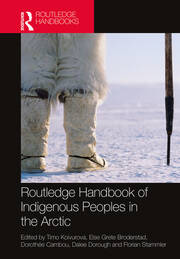
Routledge Handbook of Indigenous Peoples in the Arctic
SECTION 1 Arctic Indigenous diversity and the foundations of cultural, social and spiritual well-being
Florian Stammler
1 The role of statistics in relation to Arctic Indigenous realities
Timothy Heleniak and Olivia Napper
2 Indigenizing education in Sapmi/Norway: rights, interface and the pedagogies of discomfort and hope
Torjer A. Olsen
3 What makes a good political leader? Young people’s perceptions from the republic of Sakha (Yakutia)
Aytalina Ivanova, Matrena Okorokova, Florian Stammler, and Emma Wilson
4 Electronic devices for safeguarding Indigenous languages and cultures (Eastern Siberia)
Aleksandr Varlamov, Galina Keptuke and Alexandra Lavrillier
5 Voices of the forests, voices of the streets: popular music and modernist transformation in Sakha (Yakutia), Northeast Siberia
Eleanor Peers, Aimar Ventsel, and Lena Sidorova
6 Soviet-time Indigenous displacement on the Kola Peninsula: an extreme case of a common practice
Lukas Allemann
7 Indigenous Arctic religions
Piers Vitebsky and Anatoly Alekseyev
SECTION 2 The fundamental importance of land, territories and resources
Else Grete Broderstad and Dalee Dorough
8 Changing Indigenous territorial rights in the Russian North
Gail Fondahl, Viktoriya Filippova, Antonina Savvinova, and Vyacheslav Shadrin
9 Sami law and rights in Norway – with a focus on recent developments
Oyvind Ravna
10 Comprehending the mandate and interactions of land tenure reform in Finnmark, Norway
Else Grete Broderstad and Eva Josefsen
11 The Girjas Case – court proceedings as a strategy to enforce Sami land rights
Malin Brannstrom
12 Arctic waters as Inuit homeland
Claudio Aporta and Charlie Watt
13 Alaska Native marine mammal harvesting: the Marine Mammal Protection Act and the crisis of eligibility
Steve J. Langdon
14 Review and mapping of Indigenous knowledge concepts in the Arctic
Parnuna Egede Dahl and Pelle Tejsner
SECTION 3 Indigenous peoples and self-determination in the Arctic
Dorothee Cambou and Timo Koivurova
15 Indigenous self-government in the Arctic: assessing the scope and legitimacy in Nunavut, Greenland and Sapmi
Rauna Kuokkanen
16 Advancing Inuit self-determination and governance in Alaska and Canada amidst renewed global focus on the Arctic
Tim Aqukkasuk Argetsinger
17 Indigenous peoples’ right to self-determination: perceptions of self-determination among the Sami electorate in Sweden
Ulf Morkenstam, Ragnhild Nilsson and Stefan Dahlberg
18 Indigenous self-determination and disempowerment in the Russian North
Liubov Sulyandziga and Rodion Sulyandziga
19 The participation of Arctic Indigenous peoples’ organizations in the Arctic Council and beyond
Dorothee Cambou and Timo Koivurova
20 Legal appraisal of Arctic Indigenous peoples’ right to free, prior and informed consent
Leena Heinamaki
Epilogue: Alaska natives and climate change
Paul C. Ongtooguk
Biography
Timo Koivurova is Research Professor and Director at the Arctic Centre, University of Lapland. He has a multidisciplinary specialisation in Arctic law and government but has also conducted broader research on global law.
Else Grete Broderstad is Professor in Indigenous Studies and coordinates the Indigenous Master Programme, UiT, The Arctic University of Norway. Her research areas include Indigenous rights, political participation, governance of the Circumpolar North, resource management and conflicting interests between Indigenous traditional livelihoods and large-scale industries.
Dorothée Cambou is Assistant Professor in sustainability science at the faculty of law, HELSUS, University of Helsinki. Her research focuses on the rights of Indigenous peoples and the governance of land and natural resources in the Arctic and the Global South.
Dalee Dorough, an Inuk from Alaska, is Senior Scholar and Special Advisor on Indigenous Peoples in the Arctic, UAA. Specializing in international Indigenous human rights, she holds a PhD in law bestowed by University of British Columbia in 2002 and Master of Arts in law and diplomacy from The Fletcher School in 1991.
Florian Stammler is Coordinator of Anthropology and Research Professor at the Arctic Centre, University of Lapland. His research is on nomadism, human–environment relations, Indigenous peoples and extractive industries. His publications include Reindeer Nomads Meet the Market and Good to Eat, Good to Live With.
