




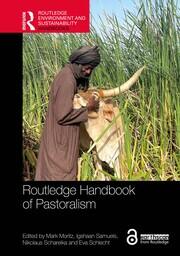
1st Edition
Routledge Handbook of Pastoralism
1. Introduction to Pastoralism
Mark Moritz, Igshaan Samuels, Nikolaus Schareika, and Eva Schlecht
Section I: The emergence of pastoralism
2. Coevolution in pastoral systems: The example of African sheep and goats
Anne Da Silva, Dominique Taurisson-Mouret, and Johannes A. Lenstra
3. Archaeology of pastoralism: Forty years of archaeological studies of pastoralism across the world
Stefano Biagetti
4. Archaeological, historical, and ethnographic analyses of changes in pastoral systems
Claudia Chang, J. Terrence McCabe, and William T.T. Taylor
Section II: Colonialism, capitalism, and commodities
5. Cattle Ranching: Handmaiden of Settler Colonialism
Shawn Van Ausdal
6. Livestock and Global Capitalism
Nathan Sayre
7. Livestock Commodities in a Globalizing World: Between Pastoralism and Capitalism
Samuël Coghe
Section III: Biophysical components of pastoralism
8. Rangeland Ecology
Shikui Dong
9. Livestock nutrition in pastoral systems
Alexandre Ickowicz, Magali Jouven, Mohamed Habibou Assouma, and Batjargal Erdenebaatar
10. The ecology of health and infectious diseases in changing pastoral systems
Bassirou Bonfoh, Simeon Cadmus, Bernard Bett, Kohei Makita, Jakob Zinsstag, Francis Sena Nuvey
11. Demographic Dynamics in Pastoral Systems
Chelsea Hunter and Mark Moritz
Section IV: Pastoral adaptations
12. Pastoral mobility
Matthew D. Turner
13. Contributions of pastoralism to climate change
Pablo Manzano, Rubén Serrano-Zulueta, and Agustín del Prado
14. Climate Change Impacts and Adaptation
Saverio Krätli, Achiba Gargule, Srijana Joshi, Wenjun Li, Zsolt Molnár, Mariana Quiroga Mendiola, Julio Sa Rego, Abolfazl Sharifian, Hussein M. Sulieman
15. Valuing pastoralist goods, services and culture
Jonathan Davies, Serena Ferrari, and Véronique Alary
16. Ecosystem services and pastoralism
Patrick O’Farrell and Pippin Anderson
Section V: Social and political organization of pastoralism
17. Pastoralist Social Organization
Nikolaus Schareika and Kaderi Noagah Bukari
18. Continuity and Change in Pastoralist Identities
María E. Fernández-Giménez and Pau Sanosa-Cols
19. Development and Gender in Herding Societies
Dawn Chatty and Ariell Ahern
20. Political organization
Thomas Barfield
21. How Pastoralists Access Natural Resources
Roy Behnke, Kirill Istomin, Carol Kerven, Martin Petrick, and Sarah Robinson
22. Between-group contest competition among pastoralists
Sarah Mathew
Section VI: Approaches to studying pastoralism
23. Spatial Analysis of Pastoral Mobility
Bilal Butt, Marlotte de Jong, Sarah Carroll, and Wenjing Xu
24. Simulation as an Approach to Pastoral System Analyses
Randall B. Boone, Melody Zarria Samanamud, Spencer Burkhart, Gregory A. Kiker, Trinity S. Senda and Rekha Warrier
25. Methodologies for understanding rangeland ecology
Igshaan Samuels, Gilbert Pule, Manam Saeed, Eric Timpong-Jones, Timm Hoffman, Piet Monegi, Ute Schmiedel, Theunis Morgenthal
26. Animal’s intentional acting and cultural understanding of behavior: the place and role of animal agentivity in pastoralism
Nicolas Bureau
27. Contributions of ethnographic and community-based methods to interdisciplinary studies of pastoralist health and wellbeing
Bilinda Straight, Lora Iannotti, and Carlos Andres Gallegos-Riofrio
28. Participatory Action Research in Pastoral Systems: Tools for Empowerment, Innovation, and Resilience
Fiona Flintan, Birgit Habermann, Bernard Bett, Shibaji Bose, Roopa Gogineni, and Elisa Oteros-Rozas
Section VII: Development of pastoralism
29. Trends in Pastoralists' Sedentarization: Causes, Consequences, and Policies Hassan G. Roba, Abolfazl Sharifian, and Hussein T. Wario
30. Divergent livelihood pathways in pastoralist areas of the Horn of Africa
Andy Catley, Ian Scoones, and Jeremy Lind
31. Humanitarian crises and responses in the Horn of Africa
Andy Catley, Yacob Aklilu, Mohamed Abdinoor, Raphael Lotira Arasio, Adrian Cullis
32. Pastoralism and Conservation: Compatibilities, Conflicts, and Promise
Mara J. Goldman, Shruthi Jagadeesh, Alicia Davis, Mohammed Meer Hamja, Saitoti Parmelo, Ryan Unks, and Esmee Mulder
33. Politics of Land Grabbing in Pastoral Territories
John G. Galaty, Kariuki Kirigia, Salau Rogei, Echi Christina Gabbert, and Justin Raycraft
Section VIII: Futures of pastoralism
34. Provisioning of social and economic services to pastoralist communities in Africa: models, impacts and prospects for improvement
Georges Djohy, Kérine G. Lohounmè, Toussaint Koutchoro, and Honorat Edja
35. Rethinking policies for pastoralists: Experiences from four world regions
Michele Nori and Ian Scoones
36. Pathways and possibilities for pastoralist youth
Natasha Maru, Serena Ferrari, Ariell Ahearn, Tahira Mohammed Shariff
Biography
Mark Moritz is Professor of Anthropology at Ohio State University, USA. He has conducted research on pastoral systems in Central Africa and Southern Arabia, using a combination of ethnographic methods, spatial analyses, comparative analyses, and agent-based modeling to explore questions about common-pool resources, the ecology of infectious diseases, and economic transformations.
Igshaan Samuels is a specialist researcher in Range and Forage Sciences at the Agricultural Research Council in South Africa. He is the Global Co-chair of the Global Alliance for the United Nations-declared International Year of Rangelands and Pastoralists in 2026.
Nikolaus Schareika is a Professor of Anthropology at the University of Göttingen, Germany. He has extensively worked in pastoral societies, particularly in groups of Woɗaaɓe and Fulani people in West Africa.
Eva Schlecht chairs the joint section Animal Husbandry in the Tropics and Subtropics at the Universities of Kassel and Göttingen, Germany. With over 30 years of research across Africa, Asia, and the Near East, she examines livestock–environment interactions, related ecosystem services, and how animal husbandry supports livelihoods and food security.
