




1st Edition
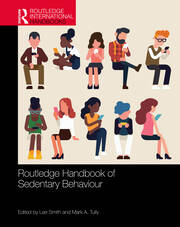
Routledge Handbook of Sedentary Behaviour
Section 1: Introduction
1. Introduction to sedentary behaviour
Lee Smith and Mark A. Tully
Section 2: Sedentary behaviour epidemiology
2. Defining sedentary behaviour and current sedentary behaviour guidelines
John P. Buckley and Stephanie A. Prince
3. Global levels and patterns of sedentary behaviour in children, adolescents, adults, and older adults
Lee Smith and Mark A. Tully
4. Correlates of sedentary behaviour across the lifespan
Jaime Mendiola Olivares, Ana Cutillas Tolín, Juan José Gascón Cánovas, and Alberto Manuel Torres Cantero
5. Global levels and correlates of sedentary behaviour in clinical populations
Eduardo L. Caputo, Mike Trott, and Felipe B. Schuch
6. Synopsis of Section 2: Sedentary behaviour epidemiology
Mark A. Tully and Lee Smith
Section 3: Measuring sedentary behaviour
7. An overview of subjective sedentary behaviour measures
Chao Cao, Ruixuan Wang, and Lin Yang
8. An overview of objective sedentary behaviour measures
Chao Cao, Ruixuan Wang, and Lin Yang
9. Sedentary behaviour: A cluster of unhealthy behaviours
Matt Jewiss and Lee Smith
10. Synopsis of Section 3: Sedentary behaviour measurement summary
Lee Smith and Mark A. Tully
Section 4: Sedentary behaviour and health outcomes
11. Physical inactivity, sedentary behaviour, and non-communicable disease
Masoud Rahmati, Rouholah Fatemi, Dong Keon Yon, and Jae Il Shin
12. Sedentary behaviour and physical non-communicable disease and risk factors in older adults and special populations
Francesco Saverio Ragusa, Nicola Veronese, Pinar Soysal, and Mario Barbagallo
13. Sedentary behaviour and mental health in adolescents
Brendon Stubbs
14. The relationship between sedentary behaviour with mental health complications and psychosocial outcomes in adults
José Francisco López-Gil
15. The relationship between sedentary behaviour and mental health complications and psychosocial outcomes in older adults and special populations
José Francisco López-Gil
16. Sedentary behaviour and cancer
Ligia J. Dominguez, Nicola Veronese, Francesco Saverio Ragusa, and Mario Barbagallo
17. Sedentary behaviour and pain
Bawan Ahmed, Lee Smith, and Trevor Thompson
18. Sedentary behaviour and obesity
Mark A. Tully and Lee Smith
19. Mechanisms linking sedentary behaviour to health outcomes
Lee Smith and Mark A. Tully
20. Synopsis of Section 4: Sedentary behaviour and health outcomes
Mark A. Tully and Lee Smith
Section 5: Sedentary behaviour interventions
21. Use of psychological theory in sedentary behaviour interventions
Stuart J.H. Biddle, Keegan Knittle, and Martin S. Hagger
22. Sedentary behaviour interventions in children
Lee Smith and Mark A. Tully
23. Sedentary behaviour interventions in adolescents
Nicole E. Blackburn
24. Sedentary behaviour interventions in adults
Damiano Pizzol and Alessandro Bertoldo
25. Sedentary behaviour interventions in older adults
Jason J. Wilson, Conor Cunningham, Malcolm Brown, Lee Smith, Paolo Caserotti, and Mark A. Tully
26. Sedentary behaviour interventions in special populations
Rubén López-Bueno and Joaquín Calatayud
27. Synopsis of Section 5: Sedentary behaviour interventions
Mark A. Tully and Lee Smith
Section 6: Conclusion
28. Conclusion
Mark A. Tully and Lee Smith
Biography
Lee Smith is an epidemiologist in the Faculty of Science and Engineering at the School of Psychology and Sport Science, Anglia Ruskin University, UK, with expertise in physical activity and sedentary behaviour. Lee researches ways in which we can increase levels of physical activity and reduce sedentary behaviour across the lifespan and within special populations.
Mark A. Tully is Research Director of the School of Medicine and Professor of Public Health at Ulster University, UK. Prof Tully’s research focuses on addressing population levels of physical inactivity and sedentary behaviour, which are major causes of poor physical and mental wellbeing. His research includes interventions targeting older adults and socioeconomically disadvantaged communities. In addition, he is interested in the effects of changes in the built environment on behaviours.
