





1st Edition
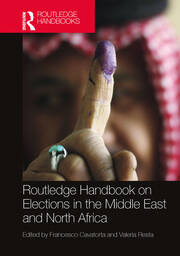
Routledge Handbook on Elections in the Middle East and North Africa
1. Elections in the Middle East and North Africa
Francesco Cavatorta and Valeria Resta
Part 1: Elections in authoritarian settings
2. The functions of authoritarian elections: symbolism, safety valves and clientelism
Matt Buehler and Calista Boyd
3. Elections and the management of plurality in Algeria
Thomas Serres
4. Parliamentary elections under Mohamed VI’s reign (2002-2021)
Inmaculada Szmolka
5. Electoral districts in Jordan: an analytical study
Mohamed Torki Bani Salameh
6. Elections in Mauritania: the role of the military
Raquel Ojeda-Garcia and Samara Lopez-Ruiz
7. "Only Me": Repression, Legal Engineering, and State-Managed Elections in Sisi’s Egypt
Hesham Sallam
Part 2: Elections in democratic and quasi-democratic settings
8. Israel's Electoral System and Political Instability: Electoral Fragmentation, Party Unity and the Prime Ministers' Political Leadership
Maoz Rosenthal
9. When free and fair elections are not enough. Party fragmentation and unaccountability in Tunisia
Ester Sigillò
10. Pre-electoral coalitions in Iraq: the case of the Communist-Sadrist alliance
Paride Turlione
11. Elections and democratic backsliding in Turkey
Sebnem Gumuscu
12. From one-sect one-vote to one-man one-vote? Demands for reforming the electoral system in Lebanon
Rosita Di Peri
13. Competition under systemic religious constraints: presidential elections in Iran
Pejman Abdolmohammadi
Part 3: Rules, institutions and the infrastructure of elections
14. The management of elections in Tunisia: the Independent High Authority for Elections
Mohamed Chafik Sarsar and Nidhal Mekki
15. Partial and non-partisan: the municipal council elections in Saudi Arabia
Hendrik Kraetzschmar
16. Elections in the Arab world: international monitoring and assistance
Pietro Marzo
17. The independence referendum in Kurdistan
Sara Dilzar Mustafa
18. Gender Quotas, Constituency Service, and Women’s Empowerment: Lessons from Algeria
Meriem Aissa
Part 4: Elections and campaigning
19. A minority goes to the polls: Arab voters in Israel
Arik Rudnitzky
20. Elections in Occupied Palestine: control, resistance and contention
Francesco Saverio Leopardi
21. Electoral campaigns in post-Ben Ali’s Tunisia: electoral expertise and renewed clientelism
Deborah Perez-Galan
22. Digital strategies of Tunisian political parties: the case of the 2018 local elections
Bader Ben Mansour
23. The role of media in electoral campaigns in the pandemic era. The case of Kuwait
Geoff Martin
24. Opposition Coordination under a Competitive Authoritarian Regime. The Case of the 2019 Local Elections in Turkey
Berk Esen and Hakan Yavuzyılmaz
25. Polarisation and elections under competitive authoritarianism: the case of Turkey after 2013
Şebnem Yardımcı Geyikçi
26. From ballots to bullets: Libyan 2012 elections as the origin of the unachieved transition
Chiara Loschi
Part 5: Voting behaviour
27. The rationality of the Arab voter
Valeria Resta
28. Clientelism in MENA elections
Miquel Pellicer and Eva Wegner
29. The consequences on Arab voters of Arab Palestinian parties’ quest for power in Israeli politics
Sawsan Khalife’
30. Class and religious cleavages. The case of Lebanon
Joseph Daher
31. Ideology and electoral choices in Arab elections
Enea Fiore
32. The Arab Generation Z: from Disillusionment to Pragmatism
Dina Shehata and Abdelmajeed Abualela
Biography
Francesco Cavatorta is Professor in the Department of Political Science, Université Laval, Québec, Canada. He is currently working on a collaborative project examining political parties and coalition governments in the Middle East and North Africa.
Valeria Resta is Guest Lecturer in the Department of Social and Political Sciences, Bocconi University, Milan, Italy. She is currently working on a collaborative project examining political parties and coalition governments in the Middle East and North Africa.
