




1st Edition
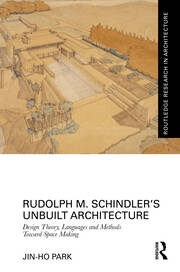
Rudolph M. Schindler’s Unbuilt Architecture Design Theory, Languages and Methods Toward Space Making
List of figures
List of tables
List of abbreviations
Acknowledgements
Introduction
Part 1: R. M. Schindler’s design theory, languages, and methods
Ch. 1 Theoretic foundations of space making
Ch. 2 Framing of space: sources and influences
Part 2: Selected unbuilt works
Ch. 3 New lights on the Workmen’s Colony of the Monolith Home (1919)
Ch. 4 Bergen Branch Library competition (1920): Unpremiated submission with the winning scheme
Ch. 5 Translucent House for Aline Barnsdall, Palos Verdes Estates (1927–1928)
Ch. 6 Braxton–Shore Beach House (1930): Departure from the 1920s
Ch. 7 Projected in and out in the Oliver House (1931)
Ch. 8 Locke House (1933): Directed rooms with L-shaped surfaces
Ch. 9 Schindler Shelters (1933–1942): Composition and construction for low-cost housing units and incremental clustering
Ch. 10 Full-blown rhythmic forms in the Shep House (1934–38)
Ch. 11 Curvilinear form in the Warshaw House (1936)
Ch. 12 Toward nonorthogonal space forms in the Timme House (1938)
Ch. 13 “Space Development” (1945) and its subsequent applications for the Braden House and the Schick House (1945) with the Schindler Frame
Ch. 14 Tilted box form in the Elmer House (1951–1952)
Conclusion
Index
Biography
Jin-Ho Park is a Professor of Architecture at Inha University in South Korea, where he teaches architectural design, theory, and history. Prior to his appointment at Inha University, he was a tenured Associate Professor at the School of Architecture, University of Hawaii at Manoa, U.S.A. He holds a Ph.D. in Architecture from the University of California, Los Angeles (UCLA). His recent publications include Pavilions for Giving (2025) and Architectural and Urban Subsymmetries (2022).
