




1st Edition
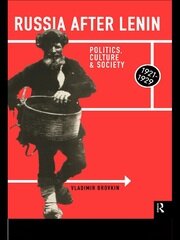
Russia After Lenin Politics, Culture and Society, 1921-1929
By Vladimir Brovkin
Copyright 1998
280 Pages
by
Routledge
280 Pages
by
Routledge
280 Pages
by
Routledge
Also available as eBook on:
Following the Russian Revolution, the cultural and political landscape of Russia was strewn with contradictions. The dictatorship, censorship and repression of the Communist party existed alongside private enterprise, the black market and open debates on Socialism. In Russian Society and politics 1921-1929 Vladimir Brovkin offers a comprehensive cultural, political, economic and social history... Read more
Introduction: Revolutionary identity 1 Extracting socially alien elements 2 The culture of the new elite, 1921–5: ascetic knights and drinking pals 3 Bolshevik actions and peasants’ reactions, 1921–5: face the village, face defeat 4 Propaganda and popular belief 5 The Komsomol and youth: a transmission belt that snapped 6 Women: false promises, dashed hopes and the pretense of Emancipation 7 Towards showdown in the countryside, 1926–8 8 The proletariat against the vanguard 9 The Bolshevik old guard and the upstarts, 1924–9: down and out and up and coming 1 Conclusion
Biography
Vladimir Brovkin is John Olin Fellow for History and Political Philosophy at the Russian Research Center, Harvard University.
'A riveting portrait of the 1920's and the rise of Stalinism ... Mr Brovkin's book is indispensable.' - Wall Street Journal
'For anyone interested in understanding how Lenin and Stalin createdthat system. Mr Brovkin's book is indispensable. It is an indictment not just of Communism but of American's revisionism.' - Jacob Heilbrunn, senior editor of the New Republic
'This is an overtly hostile but well documented, and ultimately convincing, portrayal of a Communist Party in crisis by the end of the 1920s, faced with admitting the failure on all fronts of its dreams of building socialism with popular support. Beryl Williams, The Slavonic Review
