





1st Edition
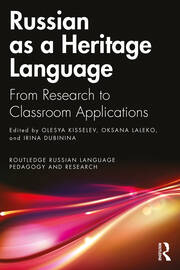
Russian as a Heritage Language From Research to Classroom Applications
1 Russian as a heritage language in the 21st century: Bridging research in linguistics and pedagogy
Olesya Kisselev, Oksana Laleko, and Irina Dubinina
Understanding heritage Russian speakers’ linguistic and pragmatic competence
2 Linguistic knowledge and proficiency assessment in heritage and L2 Russian: Classroom implications of experimental findings
Tania Ionin and Tatiana Luchkina
3 Phonetic production of Russian heritage speakers in Finland: Implications for college instruction
Olga Nenonen and Anastasiia Sergeeva
4 Forms of address in heritage Russian in Germany: Something to address in the classroom
Olia Blacher and Bernhard Brehmer
5 Pragmatics of requests in heritage Russian: Implications for the classroom
Marina Avramenko and Natalia Meir
Literacy development in heritage Russian learners
6 Writing proficiency development in learners of Russian as a heritage language in the Netherlands: A longitudinal study
Alla Peeters-Podgaevskaja
7 Register variation in the writing of Russian heritage speakers in Israel
Anna Kostina and Elitzur Bar-Asher Siegal
8 What eye movements can tell us about reading in Russian as a heritage language: From the lab to the classroom
Olga Parshina, Olesya Kisselev, and Irina Dubinina
Russian in diaspora: Community schools and communities as ‘schools’
9 Can translanguaging be a resource for teaching and learning Russian as a heritage language? Evidence from Cyprus, Estonia, and Sweden
Svetlana Karpava, Natalia Ringblom, and Anastassia Zabrodskaja
10 Past the second generation: Social, familial, and individual factors in maintaining Russian as a heritage language in Israel
Marina Niznik
11 Russian as a heritage language in Spain: Educational opportunities for language maintenance
Olga Ivanova and Nina Kressova Iordanishvili
12 The acquisition of Russian by multilingual children in Canada: Heritage language proficiency, language attitudes, and linguacultural exposure
Veronika Makarova and Natalia Terekhova
Afterword: Russian without borders
Maria Polinsky
Biography
Olesya Kisselev is Assistant Professor in the Department of Languages, Literatures and Cultures at the University of South Carolina, USA. Kisselev’s research expertise lies in the areas of heritage and second language acquisition, language pedagogy and learner corpus research. Her scholarly contributions include research papers and book chapters on linguistic aspects of learner language varieties as well as on language pedagogy.
Oksana Laleko is Associate Professor and Director of Linguistics at the State University of New York at New Paltz, USA, and a book reviews editor of the Heritage Language Journal. She is the author of numerous articles and book chapters on formal linguistic, cognitive, and sociolinguistic dimensions of heritage language bilingualism.
Irina Dubinina is Professor of Russian and Director of the Russian Language Program in the Department of German, Russian, and Asian Languages and Literature at Brandeis University, USA. Her research focuses on pragmatics of heritage Russian and heritage language pedagogy, which are the topics of her recent publications. Dubinina is an experienced instructor of Russian as a second and a heritage language.
