





1st Edition
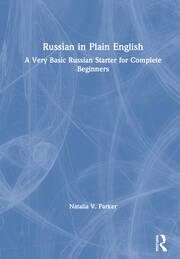
Russian in Plain English A Very Basic Russian Starter for Complete Beginners
CONTENTS
Preface
Preface for Teachers
Acknowledgements
First things first
UNIT 1. Getting Started
Something Old, Something New (Revision of Unit 1)
UNIT 2. Questions and Answers
Something Old, Something New (Revision of Unit 2)
Unit 3. Mine or Yours
Something Old, Something New (Revision of Unit 3)
Unit 4. Excuse me. Have you got a pen?
Something Old, Something New (Revision of Unit 4)
Unit 5. Say "please"
Something Old, Something New (Revision of Unit 5)
Unit 6. Where are you?
Something Old, Something New (Revision of Unit 6)
Unit 7. Work or play?
Something Old, Something New (Revision of Unit 7)
Unit 8. Where do you live?
Something Old, Something New (Revision of Unit 8)
Unit 9. Is Red Square big?
Something Old, Something New (Revision of Unit 9)
Unit 10. What is he/she up to?
Final revision
Russian alphabet
Cultural and historical background
Dictionary
Grammar index
Pronunciation index, including letter-sound correspondence
Biography
Natalia V. Parker is a keen educator and language practitioner. Trained in foreign language teaching in Russia, she held a full-time teaching post at Tula University, which she left to set up one of the first non-state, non-profit schools implementing more up-to-date teaching. At the age of 27, she became a head of school. After moving to the UK, Natalia taught Russian for several years, developing a new teaching methodology. She returned to higher education in 2016, doing an MA in Applied Linguistics at the University of Sheffield. Her teaching experiment produced extremely successful results which enabled her to secure an Arts and Humanities Research Council (AHRC) Studentship, awarded by the White Rose College of Arts and Humanities (WRoCAH) for her PhD at the University of Leeds. In 2019 she presented the results of her research at the American Association of Teachers of Slavic and East European Languages (AATSEEL) Conference and at the British Association for Slavonic and East European Studies (BASEES) Conference, among other forums. Currently, Natalia is running another pedagogical experiment on teaching Russian grammar.
