



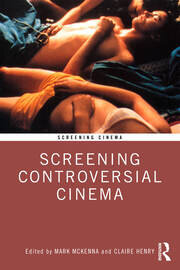
Cinematic Controversy: Structural, Recurring, Contingent
Claire Henry and Mark McKenna
1. Anders als die Andern (1919)
Valerio Sbravatti
2. Frankenstein (1931)
Basil Glynn
3. The Blonde Captive (1932)
Ben Goldsmith
4. Freaks (1932)
Sharon Coleclough
5. Jud Süß (1940)
Nathan Abrams and Michael Lipiner
6. The Moon and Sixpence (1942)
Carolyn Owen-King
7. To Be or Not to Be (1942)
Sonia García López
8. Old Acquaintance (1943)
Martin Shingler
9. Song of the South (1946)
William J. Lorenzo
10. Bad Day at Black Rock (1955)
James I. Deutsch
11. The Children’s Hour (1961)
Julia Erhart
12. Viridiana (1961)
Jesús Jiménez-Varea
13. Titicut Follies (1967)
Carolyn Anderson and Thomas W. Benson
14. Ulysses (1967)
Maria O’Brien
15. Targets (1968)
Michael J.T. Stock
16. Animal Farm (n.d.)
Oliver Carter
17. Billy Boy (1971)
Farrah Freibert
18. A Clockwork Orange (1971)
James Fenwick
19. The Devils (1971)
Sian Barber
20. Fritz the Cat (1972)
Noel Brown
21. The Texas Chain Saw Massacre (1974)
Nessa Johnston
22. Pure Shit (1975)
Philippa Hawker
23. Snuff (1976)
Mark McKenna
24. The Sentinel (1977)
John Paul Green
25. Caligula (1979)
Eddie Falvey
26. Cannibal Holocaust (1980)
Bethany Rose Lamont
27. Personal Best (1982)
Maria San Filippo
28. White Dog (1982)
Andrew Howe
29. Red Dawn (1984)
Alfio Leotta
30. A Fire in My Belly (1986-1987/2010)
Tom Day
31. Child’s Play 3 (1991)
Benjamin Litherland and Richard McCulloch
32. Braindead (1992)
George Evander Cunningham
33. Man Bites Dog (1992)
Duncan Hubber
34. Kids (1995)
Thomas Joseph Watson
35. Boys Don’t Cry (1999)
Adam Vaughan
36. Baise-Moi (2000)
Jade Jontef
37. August Underground’s Mordum (2003)
Jacob Engelberg
38. The Passion of the Christ (2004)
Zachary Sheldon
39. Imprint (2006)
Darren Kerr
40. This is England (2006)
Lewis Kellett
41. Martyrs (2008)
Rhys Steven Jones
42. A Serbian Film (2010)
William Proctor
43. Django Unchained (2012)
Peter Turner
44. The Lords of Salem (2012)
Amandine Pierron
45. Mother! (2017)
Andrew Stubbs-Lacy
46. Lords of Chaos (2018)
Lucy Weir
47. Cuties (Mignonnes, 2020)
S.A. Wilder
48. The Trouble With Being Born (2020)
Claire Henry
49. The Scary of Sixty-First (2021)
Nicholas Godfrey
50. Blonde (2022)
David Sorfa
51. Saltburn (2023)
Claire Whitley
52. Civil War (2024)
Peter Krämer and Stevie Simkin
Biography
Mark McKenna teaches creative and cultural industries at the University of Sheffield, and his work explores these industries from a range of perspectives. He is the author of several books including Nasty Business: The Marketing and Distribution of the Video Nasties (2020), Snuff (2022), Big Wednesday (2024) and Levelling Up the Screen Industries? (2025) and co-editor of Horror Franchise Cinema (2021).
Claire Henry is an Associate Professor in Screen at Flinders University and an Australian Research Council DECRA Fellow (2025-2028). She is the author of Revisionist Rape-Revenge: Redefining a Film Genre (2014) and Eraserhead (2023), and co-author of Screening the Posthuman (2023). Over the past twenty years, she has taught film and media studies at universities in Australia, New Zealand, and the UK.
"Controversial cinema is a minefield but this volume expertly navigates how films surrounded by scandal and storm can be approached with due care and caution without ignoring their explosivity. The editors’ emphasis on controversy as a structural component of cinema gives Screening Controversial Cinema a solid organizational coherence. The range of films selected here is exquisite, from the notorious to the misunderstood, with ample room for films supposedly ‘bad for you’. From Freaks over Jud Süß and Song of the South to A Serbian Film and Civil War, each film is intelligently approached in function of its position as a teachable object of controversy. This is an essential text for film education, a book any instructor will welcome."
- Ernest Mathijs, Professor in Cinema and Media Studies, University of British Columbia, Vancouver, Canada"This volume brings new energy and insight to a thoughtfully curated selection of films that have pressed against dominant codes, norms, and values—and have come to be regarded as controversial texts. Drawing on examples across diverse periods, national contexts, and aesthetic forms, Screening Controversial Cinema examines the historical and political contexts that have shaped these scandalous works, offering a nuanced account of how and why certain films provoke public debate and cultural anxiety."
- Tina Kendall, Associate Professor of Film and Media, Anglia Ruskin University, Cambridge, UK
