




1st Edition
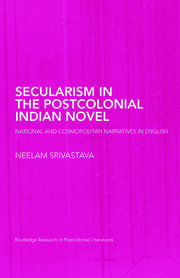
Secularism in the Postcolonial Indian Novel National and Cosmopolitan Narratives in English
By Neelam Srivastava
Copyright 2008
224 Pages
by
Routledge
224 Pages
by
Routledge
224 Pages
by
Routledge
Also available as eBook on:
This study explores the connections between a secular Indian nation and fiction in English by a number of postcolonial Indian writers of the 1980s and 90s. Examining writers such as Vikram Seth, Salman Rushdie, Amitav Ghosh, Shashi Tharoor, and Rohinton Mistry, with particularly close readings of Midnight‘s Children, A Suitable Boy, The Shadow Lines and The Satanic Verses, Neelam Srivastava... Read more
Introduction Chapter One: Theories of Secularism Chapter Two: Minority Identity in India: Midnight’s Children and A Suitable Boy Chapter Three: Secularism and Syncretism in The Shadow Lines and The Satanic Verses Chapter Four: Allegory and Realism in the Postcolonial Indian Novel Chapter Five: The Historical Event in the Postcolonial Indian Novel –I Chapter Six: The Historical Event in the Postcolonial Indian Novel – II Chapter Seven: Languages of the Nation in Salman Rushdie’s Midnight’s Children and Vikram Seth’s A Suitable Boy Chapter Eight: Cosmopolitanism and Globalization in Rushdie and Seth
Biography
Neelam Srivastava is lecturer in postcolonial literature at Newcastle University, UK. She has published on Indian literature in English and anti-colonial cinema, and has co-edited a special issue of the journal Interventions on colonial and postcolonial Italy.
