




1st Edition
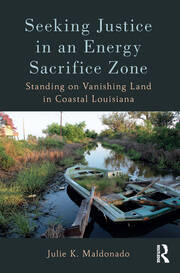
Seeking Justice in an Energy Sacrifice Zone Standing on Vanishing Land in Coastal Louisiana
Introduction
1. A Climate of Change
2. Entrée into Coastal Louisiana: Seeing the Unexpected
3. Co-occurring and Accumulating Disasters
4. A Legacy of Atrocities: Establishing an Energy Sacrifice Zone
5. Corexit to Forget It: The BP Deepwater Horizon Oil Disaster
6. Adaptation and Resistance
7. Community-led Resettlement: Obstacles, Challenges, and Opportunities
8. A Call to Action: “We Have Got to Slow the Rising Tide”
Conclusion
Appendix: Additional Resources
Biography
Julie K. Maldonado is Director of Research for the Livelihoods Knowledge Exchange Network (LiKEN) and a lecturer in the Environmental Studies Program at the University of California-Santa Barbara, USA. She works with the Institute for Tribal Environmental Professionals and co-facilitates "Rising Voices: Collaborative Science with Indigenous Knowledge for Climate Solutions". Her work focuses on climate adaptation, disasters, displacement, resettlement, and environmental and climate justice.
"A tour de force of big oil, climate change, fresh oysters, and family ties. […] Students are going to love it, and anyone who loves Louisiana or is curious about climate change is going to be motivated to act."
Elizabeth Marino, Oregon State University - Cascades, USA"A journey to the Louisiana bayous that illustrates how global and historical processes trap local communities between the rock of fossil fuel extraction and the hard place of deteriorating local environments. […] Through her compassionate attention to people’s stories and experiences, Maldonado provides a compelling analysis of communities enmeshed in broader processes of climate change, energy production, community resettlement, and justice."
Heather Lazrus, National Center for Atmospheric Research, USA
