



1st Edition
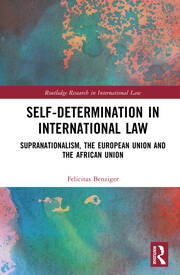
Self-Determination in International Law Supranationalism, the European Union and the African Union
1. Introduction
2. From Ideology to Principle: The Conceptual Evolution of Self-Determination
3. Supranationalism: Processes, Institutions and the Limits of Categorisation
4. Self-Determination of Peoples in International Law
5. Pan-Africanism and Pan-Europeanism: Divergent Pathways to Supranational Order
6. Self-Determination of Peoples and Supranationalism in the European Union
7. Self-Determination of Peoples and Supranationalism in the African Union
8. Conclusion
Biography
Felicitas Benziger is a Lecturer in Law at University College Cork in Ireland. Her research focuses on international and comparative law, with particular interests in self-determination of peoples and supranationalism. She has contributed to research on human rights and constitutional law, including the protection of the inner self, freedom of thought, privacy and mental integrity in the digital age as part of the Law and Inner Self Project, funded by a Research Ireland Laureate (Consolidator) Grant (2022–2026). While primarily grounded in legal methodology, her research incorporates interdisciplinary perspectives from philosophy, sociology and the wider humanities.
This monograph offers a compelling and original contribution to international legal scholarship, addressing a critical gap in the literature by examining the principle of self-determination within the context of supranationalism. Framed through developments in the European Union and the African Union, the book combines rigorous legal analysis with rich interdisciplinary insight. Engaging thoughtfully with contemporary debates and policy implications, it demonstrates a deep command of relevant legal frameworks while advancing the discourse on the evolving challenges facing the international legal order. An essential work for scholars, policy makers and practitioners interested in self-determination, regional integration, and the future of international law.
Professor Femi Amao, University College Cork
This book offers incisive insights into an emerging debate in contemporary international law: the relationship between self-determination and supranational organisations. With analytical clarity and impressive nuance, it navigates the often contested questions surrounding the nature and rights of peoples, as well as the role and authority of supranational institutions. It is essential reading for students, scholars, and policymakers working across the field of international law.
Dr Joelle Grogan, EU Legal Scholar
