





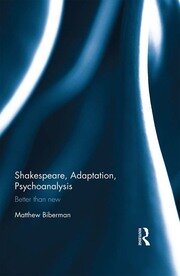
1st Edition
Shakespeare, Adaptation, Psychoanalysis Better than New
CONTENTS
Note on Sources
List of Illustrations
Acknowledgements
Introduction: Beyond Bad Style, or the Curious Case of Adaptation
Chapter One: On Primary Adaptation: The Case of Nahum Tate’s "King Lear"
Chapter Two: Instances of Secondary Adaptation: Otway, Davenant and the Birth of the Cross-Over Episode
Chapter Three: Synchronous Adaptation: Hamlet, Macbeth, and the Double Falsehood
Chapter Four: Love and Adaptation: Antony and Cleopatra, Dryden’s All for Love, and Coriolanus
Chapter Five: Comedy, Tragedy, and Adaptation: The Tempest, The Enchanted Island, and Hamlet
Conclusion: Bad Style II, or Notes toward a Theory of Adaptation
Bibliography
Index
Biography
Matthew Biberman is Professor of English at the University of Louisville, USA. He is also the author of Masculinity, Anti-Semitism and Early Modern English Literature (Ashgate, 2004) and the memoir Big Sid's Vincati (2009).
