




1st Edition
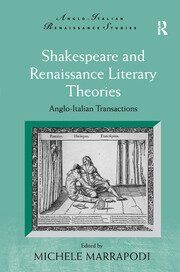
Shakespeare and Renaissance Literary Theories Anglo-Italian Transactions
Edited By Michele Marrapodi
Copyright 2011
340 Pages
by
Routledge
338 Pages
by
Routledge
338 Pages
by
Routledge
Also available as eBook on:
Throwing fresh light on a much discussed but still controversial field, this collection of essays places the presence of Italian literary theories against and alongside the background of English dramatic traditions, to assess this influence in the emergence of Elizabethan theatrical convention and the innovative dramatic practices under the early Stuarts. Contributors respond anew to the process... Read more
Introduction Shakespeare against Genres; I: Art, Rhetoric, Style; 1: Sheakespeare and the Art of Forgetting; 2: Shakespearean Comedy: Postmodern Theory and Humanist Poetics; 3: Shakespeare: What Rhetoric Accomplishes; 4: Shakespearean Outdoings: Titus Andronicus and Italian Renaissance Tragedy; 5: Transalpine Wonders: Shakespeare's Marvelous Aesthetics; II: Genres, Models, Forms; 6: Hamlet versus Commedia dell'Arte; 7: The End of Shakespeare's Machiavellian Moment: Julius Caesar, Shakespeare's Historiography, and Dramatic Form; 8: The Problem of Old Age: Anticomedy in As You Like It and Ruzante's L'Anconitana; 9: Ruzante and Shakespeare: A Comparative Case-Study; 10: The ‘Woman as Wonder' Trope: From Commedia Grave to Shakespeare's Pericles and the Last Plays; III: Spectacle, Aesthetics, Representation; 11: Shakespeare's Italian Carnival: Venice and Verona Revisited; 12: (Re)fracted Art and Ordered Nature: Italian Renaissance Aesthetics in Shakespeare's Richard II; 13: 'Tis Pity She's Italian: Performing the Courtesan on the Early Seventeenth-Century English Stage; 14: Silence, Seeing, and Performativity: Shakespeare and the Paragone; 15: Italian Spectacle and the Worlds of James VI/I; IV: Coda; 16: How Do We Know When Worlds Meet?
Biography
Michele Marrapodi is Full Professor of English Language and Literature, and History of English Drama, in the Faculty of Arts at the University of Palermo, Italy.
'... [a] valuable collection...'Journal of Anglo-Italian Studies 'Marrapodi judiciously allows his contributors to range widely. The book demonstrates how the field of Anglo-Italian studies is in contact with many other areas of current research. In a book that is itself so concerned with intertexts and intellectual matrives, Marrapodi rightly strives for, and achieves, a sense of diffusion.' Renaissance Quarterly
