




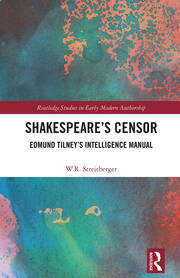
1st Edition
Shakespeare’s Censor Edmund Tilney’s Intelligence Manual
Introduction, Chapter 1. Authorship, Genre, Sources, Chapter 2. History, Chronologies, Regiments, Chapter 3. Legend and History, Chapter 4. Religion and Politics, Chapter 5. Licensing and Censorship: the Oldcastle/Falstaff Controversy and the book of Sir Thomas More, Chapter 6. PrProducing Shakespeare at Court, Conclusion, Index
Biography
W.R. Streitberger is Professor of English and a faculty member in the Interdisciplinary Textual Studies Program at the University of Washington, Seattle. He has dedicated an entire scholarly career to the study of the early modern English court and its management of entertainments and is recognized as the leading modern authority on the subject. Some of his more important earlier books include Tudor Court Revels, 1485-1559 (Toronto, 1994), Jacobean and Caroline Revels Accounts (Malone Society Collections XIII, 1986), and the David Bevington Prize winner The Masters of the Revels and Elizabeth I’s Court Theatre (Oxford, 2016).
"Streitberger takes you into the mind which licensed most of Shakespeare’s plays and reveals a surprising place, deeply absorbed in European theology, history and diplomacy while engaged in supplying suitable entertainment for his monarch. We will never get closer to what sophisticated Elizabethans saw when they read a Shakespeare play."
- Richard Dutton, Ohio State University (Emeritus)
"Streitberger offers the first in-depth analysis of Edmund Tilney’s life’s work, ‘Topographical Descriptions’, a fascinating example of diplomatic literature that combined political information gathering with humanist historiography. Streitberger’s meticulous research fills an important gap in our understanding, providing insight into the knowledge and sensibilities of this significant figure of Elizabethan theatre."
- Elizabeth R. Williamson, University of Exeter
"This book is a significant addition to existing scholarship on censorship and state control of the Elizabethan stage. Streitberger strengthens the view that Edmund Tilney was no mere censorious bureaucrat, but an enabler of the drama; brings to light the contents of Tilney's ‘intelligence manual’, as yet buried in the archives; and throws light on the regulatory, licensing and censorship practices of the Elizabethan and Jacobean state in the context of a wider consideration of humanist culture."
- Graham Holderness, University of Hertfordshire (Emeritus)
