





1st Edition
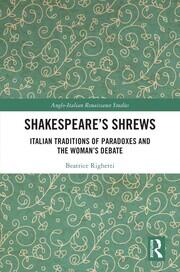
Shakespeare’s Shrews Italian Traditions of Paradoxes and the Woman’s Debate
Contents
Foreword by Rocco Coronato
Acknowledgments
Introduction. “There’s a double tongue; there’s two tongues”
Chapter 1 – “A wonderfull thing to hear”: paradoxes and the woman’s question as early modern literary traditions
1.1 – Paradoxical argumentation and its fortune in early modern England and Italy
The classical tradition of paradoxical rhetoric
Universities, Inns of Court, and Italian humanists
The early modern paradox: the mock encomium as an epistemological tool
Between Italy, France and England: the case of Ortensio Lando’s Paradossi
A paradoxical development: the mock encomium and the argumentum contra opinionem omnium
1.2 – The woman’s question and its paradoxical portrayal of the female sex
Literary antecedents and foundational texts of the woman’s question
The woman’s question in early modern Italy: Moderata Fonte and Lucrezia Marinella
The woman’s question in early modern England: the Swetnam controversy
1.3 – The paradox of the talkative woman in early modern Italy and England
Italian talkativeness: from the Roman slave to the masks of the commedia dell’arte
English talkativeness: folktale shrews and Shakespeare’s Kate
The Italian cortigiana and the English shrew: a comparison
Chapter 2 – The role of Italian mediators in the English debate on women and paradoxical literary tradition
2.1 – Of women and agency in Ariosto’s Orlando Furioso and Harington’s translation
Female infidelity and homosocial relations in Canto IV and Canto XXVIII
Translating misogyny: omissions, additions, and alterations
2.2 – Witty women at the court of Baldassare Castiglione’s Il libro del cortegiano
An Italian turned English: Thomas Hoby’s The Book of the Courtier
A necessary presence: the ordering role of women in Castiglione’s Il Cortegiano and Thomas Hoby’s The Courtier
2.3 – Ercole and Torquato Tasso’s Dell’ammogliarsi, Robert Tofte’s translation, and the “Bishops’ Ban”
“Fained battles, fought in iest”: paradoxical misogyny in Tofte’s translation
Misogynistic anecdotes and the Queen’s praise in Torquato’s defense
Chapter 3 – “So sweet was ne’er so fatal”: the woman’s question and paradoxes in Shakespeare’s shrews
3.1 – The Taming of the Shrew: a shrew-taming narrative in paradoxical terms
The pamphlet literature and the competing representations of the shrew
Petruchio’s pars destruens: coercion and resistance through paradoxes
Petruchio’s pars construens: the case of Kate’s new identity
“My tongue will tell the anger of my heart”
3.2 – Something new, something old: the use of paradoxes and the woman’s question in Much Ado About Nothing
Idealised partners in Shakespeare’s Messina
“Thou thinkest I am in sport”: love talks and logical paradoxes
The church scene and the shift in the use of paradoxes
“Guarded with fragments”
3.3 – “My lord is not my lord”: paradoxes as figures of the soul in Othello
The stage misogynist and the effects of slander
“It is their husbands’ faults”: Emilia’s defence of women
Iago’s poison: paradoxes as cyphers of tragedy and power imbalances
“A word or two before you go”
Conclusion – Figures of thought and thematical dispersion
Opposite developments: the relationship between the woman’s question and paradoxes
The variable of gender in the form and function of paradoxes
The shrew’s éndoxa, women writers, and the resolution of the paradox
Index
Biography
Beatrice Righetti is a Postdoctoral Researcher in Renaissance English Literature at the University of Verona and member of the “Shakespeare’s Narrative Sources: Italian Novellas and their European Dissemination” and “Classical and Early Modern Paradoxes” projects. She has published on Renaissance women writers and Shakespearean plays, examining the use of paradoxes, gender‑based violence, and Anglo‑Italian relations in Routledge edited volumes, NJES, and Linguae&.
