





1st Edition
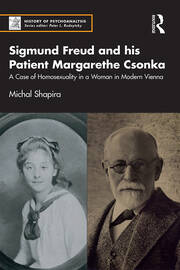
Sigmund Freud and his Patient Margarethe Csonka A Case of Homosexuality in a Woman in Modern Vienna
Biography
Michal Shapira, PhD, is Associate Professor in the History Department at Tel Aviv University, Israel. She previously taught at Barnard College, Columbia University and Amherst College.
'Michal Shapira’s brilliant close analysis of Sigmund Freud’s final published case study, his 1920 "The Psychogenesis of a Case of Homosexuality in a Woman," has been the least examined but perhaps one of the most relevant of his cases for our time. Shapira provides the first serious account of the circumstances and implications of his case study not only in the light of Freud’s complex dealing with racism and misogyny in his Vienna, but also the evolution of the notion of sexual perversions from the clinical and forensic psychiatry of the late 19th century through to the rise of psychoanalysis. Given the fact that the former have now reappeared on the right across the world, Shapira provides a guide to understanding their function and their political as well as personal ramifications. A book of true importance today.'Sander L. Gilman, author of Freud, Race, and Gender
'Michal Shapira provides a lucid, vivid, and compelling new account of Freud’s least well-known case study. I thoroughly recommend this study to anyone interested in the history of psychoanalysis, or concerned with the vicissitudes of gender and sexuality, identity and politics in early twentieth-century Europe.'
Daniel Pick, psychoanalyst, British Psychoanalytical Society; Professor of History, University of London
'Michal Shapira’s latest book is a refreshing, original and revealing exploration of one of Freud’s most intriguing, misunderstood and neglected case studies, the case of the female homosexual, Margarethe Csonka, who also used the pseudonym, Sidonie Csillag. Michal Shapira has developed and filled out Freud’s rather short discussion of the case by illuminating his patient’s life and relationships in inter-war Vienna with historical research that fills in her world in rich detail. A remarkable book on a singular, resistant woman whose encounters with Freud changed the course of psychoanalysis and prefigured of our contemporary concepts of feminism, gay rights and queer theory.'
Elizabeth Grosz, author of Jacques Lacan: A Feminist Introduction (Routledge, 1990)
'A brilliant overview of early sexology and Freud’s relationship to the field. By situating Freud within the intellectual, political, and cultural context of his time, Shapira offers a provocative and nuanced take on Freud’s views of homosexuality. Shapira uniquely pairs a close reading of Freud’s long-overlooked 1920 case study on homosexuality in women with other records of the patient’s life and times, offering an innovative assessment of same-sex desire among women and the limits of psychoanalysis. A must-read for historians of sexuality.'
Jen Manion, Ph.D, Professor of History and Sexuality, Women's & Gender Studies, Amherst College
'A "fool who had a filthy imagination." Thus did the subject of Freud's sixth and final case describe him much later in life. But in Michal Shapira's discerning hands, the 1920 case of a "female homosexual" opens up a Viennese world of emancipation and daring: of glass bathtubs, love under Secessionist arches, commodious private telephone boxes – and a Freud who was much more radical than his critics often acknowledge.'
Deborah Cohen, Northwestern University, Department of History
'Drawing on recent material, Shapira provides a many-tentacled, contextual approach to Freud’s 'Case of a Female Homosexual', linking sexology, criminal law, Jewish life and urban history to elaborate on Freud’s own radical ideas.'
Lisa Appignanesi, Co-Author of Freud’s Women
