



1st Edition
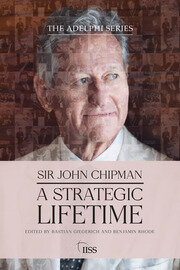
Sir John Chipman A Strategic Lifetime
Contributors
Preface
Mark Sedwill
Introduction
Bastian Giegerich
Strategic studies after the Cold War
Chapter One: The future of strategic studies: beyond even grand strategy
Survival 34-1, 1992
John Chipman
Chapter Two: Managing the politics of parochialism
Survival 35-1, 1993
John Chipman
Chapter Three: Strategic studies after the Cold War
Sir Lawrence Freedman
Chapter Four: Sir John Chipman’s ‘politics of parochialism’ and contemporary conflicts
Peter Maurer
Regionalism and regional security
Chapter Five: French military policy and African security
Adelphi Paper 201, 1985
Introduction: The logic of French power in Africa
Chapter One: The historical basis of French actions in Africa
Chapter Two: The present structure of French–African military relations
Chapter Three: Incentives and constraints
Chapter Four: Francophone African security structures and prospects
Conclusion: Between dogma and reality
Annex A: French military intervention in black Africa
Annex B: Armed forces of Sub-Saharan francophone states
Annex C: Numbers of African officers training in France
Annex D: Military co-operation budgets
Notes
John Chipman
Chapter Six: The new regionalism: avoiding strategic hubris
Originally published in Denny Roy (ed.), The New Security Agenda in the Asia-Pacific Region (London: Palgrave Macmillan, 1997)
John Chipman
Chapter Seven: South America: framing regional security
Survival 51-6, 2009
John Chipman and James Lockhart Smith
Chapter Eight: Plus ça change…?
François Heisbourg
Chapter Nine: Reflections on regionalism and regional security in East Asia
Bilahari Kausikan
Chapter Ten: South American security 15 years on: still unframed
Irene Mia
Corporate foreign policy
Chapter Eleven: Why your company needs a foreign policy
Harvard Business Review, September 2016
John Chipman
Chapter Twelve: The business of geopolitics
John Raine
Chapter Thirteen: Corporate foreign policy: a view from inside the boardroom
Grace Reksten Skaugen
Conclusion: ‘Si monumentum requiris, circumspice’
Bill Emmott
Index
Biography
Sir John Chipman KCMG was Director-General and Chief Executive of the International Institute for Strategic Studies (IISS) from 1993 to 2023. During this time, he directed its growth globally as the world’s premier institute providing facts and analysis on international security issues. It grew during his tenure from one small office in London to a large London headquarters with international offices in Washington DC, Singapore, Manama and Berlin. He developed the Institute’s role as a convener of vital inter-governmental summits, conceiving and establishing two regional security institutions under IISS auspices: in the Asia-Pacific the IISS Shangri-La Dialogue hosted by Singapore, and in the Middle East the IISS Manama Dialogue hosted by Bahrain. As Executive Chairman, he has helped to maintain the Institute’s relations with leaders in government and the corporate world globally, and worked to open new markets for the IISS in support of the strategy of his successor, Dr Bastian Giegerich. He has served on a variety of corporate international advisory boards and company boards of directors and consults widely for businesses with international interests. He speaks regularly to business audiences on political risk, regional security and global trends. He holds a BA (Hons) from Harvard, an MA (Distinction) from the London School of Economics, and an MPhil and DPhil from Balliol College, University of Oxford. Prior to assuming the Directorship of the IISS in 1993 he served there as a Research Associate (1983–84), Assistant Director (1987–90) and Director of Studies (1990–93), with a spell (1985–87) as a Research Associate at the Atlantic Institute for International Affairs in Paris. He was appointed a Knight Commander of The Most Distinguished Order of St Michael and St George (KCMG) in His Majesty The King’s Birthday Honours in June 2023 ‘for services to international peace and security’, having been made a Companion of the Order (CMG) in the Queen’s Birthday Honours in 1999.
Dr Bastian Giegerich is the Director-General and Chief Executive of the IISS. Prior to assuming the Directorship in October 2023, Bastian served as Director of the Institute’s Defence and Military Analysis research programme (2015–23), leading the team that produces the IISS annual flagship publication The Military Balance, overseeing the development of the Military Balance+ online database, and contributing to research and consultancy work. From 2010 to 2015, he worked for the German Federal Ministry of Defence in research and policy roles, while also serving as an IISS Consulting Senior Fellow for European security. He initially joined the IISS in 2005 on a postdoctoral fellowship to work on European military crisis-management efforts. He is the author and editor of several books on European security and defence matters, including (with Maximillian Terhalle) the Adelphi book The Responsibility to Defend: Rethinking Germany’s Strategic Culture (2021). He has taught international relations, military studies and public-administration courses at the London School of Economics, the University of Potsdam and the University of Kassel. He holds a Master’s in political science from the University of Potsdam and a PhD in international relations from the London School of Economics. During the 1999–2000 academic year he was a Fulbright Scholar at the University of Maryland’s School of Public Policy.
Dr Benjamin Rhode is Editor of the Adelphi Series and Senior Fellow for History and Strategy at the IISS. Ben’s research addresses the past, present and future of transatlantic relations, the changing nature of power and alliances in the twenty-first century, and ways in which history can inform our understanding of the present. Ben worked for five years at the IISS at the beginning of his career, focusing mainly on non-proliferation and regional security issues. Prior to returning to the Institute, he was an Ernest May fellow in history and policy at the Belfer Center for Science and International Affairs, Harvard Kennedy School, where he had earlier served as a senior research associate. Ben holds a BA (First Class Honours) and a doctorate in history from the University of Oxford. He also holds an MSc in international relations from the London School of Economics.
