




1st Edition
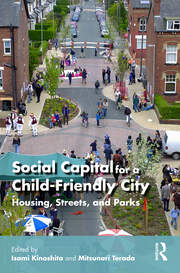
Social Capital for a Child-Friendly City Housing, Streets, and Parks
Part I Introduction: children’s outdoor play and social capital
1. Swinging in the virtual playground: children's perspectives on green time and screen time
Mitsunari Terada and Mariia Ermilova
2. Social capital and children’s outdoor play
Isami Kinoshita
Part II Cooperative and collective housing spaces
3. Requirements of community and individual development on outdoor space design: from Freidorf, Switzerland
Urs Maurer
4. Ackermanbogen in Munich, a modern, child-friendly urban village
Kati Landsiedel
5. Child-rearing social capital in collective housing in Japan
Nobuko Matusmoto
Part III Play spaces and the Bullerby model
6. Children’s planned and unplanned places of play and encounter in West Herttoniemi, Helsinki
Veera Moll and Eva Purkarthofer
7. Bullerby and the value of physical environments for social capital: a Swedish example in times of change
Marit Jansson
8. Bullerby children in today’s Japan: how they play and who supports them
Mari Yoshinaga
Part IV Streets, parks, and neighborhoods
9. Children’s outdoor play and social capital: insights from one London housing scheme
Tim Gill
10. Sharing the street and town is essential for children’s growth: from the perspective of machi hoiku ('community-embedded nursery')
Norie Miwa
Part V Conclusion
11. Pattern language to raise social capital for a child-friendly city
Isami Kinoshita and Mitsunari Terada
Biography
Isami Kinoshita is a Professor at Otsuma Women’s University and Professor Emeritus at Chiba University.
Mitsunari Terada (Charlie) is a landscape planner and researcher, and is an Assistant Professor at Nippon Sport Science University.
This book’s international comparative character that shows that urban childhood may differ globally but overall shares a decline in the building of children’s social capital. This is both a sincere loss for children growing up urban and a loss for cities. The social fabric of cities is only deteriorating when we don’t change this negative trend. This book was written with a focus on children's outdoor play and social capital, drawing on the results of joint research by researchers from Japan, Sweden, Finland, Germany, Switzerland, and the United Kingdom.
This is a groundbreaking book that suggests ways to rebuild social capital so that children can play outside and grow. Today, there is a tendency to describe about social capital in terms of IT networks. But contrary, this book is showing its originality advocating that social capital through real place is important for children's growth, and presents theories and concrete methods reflecting research findings.
Although there are differences in culture, systems, and social backgrounds between the West and the East, this book transcends these differences and specifically identifies the common spatial and social conditions that promote children's outdoor play. In the final chapter, applying the pattern language method, and follow the illustrated keyword method to extract 107 patterns and show how to review and improve familiar spaces. This book is a must-read not only for children-related researchers and experts, but also for those in charge of urban planning and local government policies.
Lia Karsten, University of Amsterdam, the Netherlands/UNIMORE University, Italy
