



1st Edition
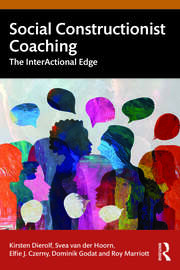
Social Constructionist Coaching The InterActional Edge
1: Introduction, Kirsten Dierolf and Svea van der Hoorn 2: The Postmodern, Social Constructionist landscape – why and how the philosophical, epistemological, methodological habitats of coaching matter, Kirsten Dierolf and Svea van der Hoorn 3: Microanalysis of InterActional Coaching conversations, Dominik Godat and Elfie J. Czerny 4: What does InterActional Coaching look like in practice? Roy Marriott and Kirsten Dierolf 5: Different applications of InterActional Coaching, Elfie J. Czerny, Kirsten Dierolf, Dominik Godat, Roy Marriott and Svea van der Hoorn 6: Developing yourself as a coach, Elfie J. Czerny, Kirsten Dierolf, and Dominik Godat 7: InterActional Coaching and the world of coaching accreditation, Svea van der Hoorn, Elfie J. Czerny and Kirsten Dierolf 8: Outlook on the coaching profession – what is lacking and what we would welcome, Kirsten Dierolf and Svea van der Hoorn
Biography
Kirsten Dierolf, founder of SolutionsAcademy, is an internationally recognised contributor to Social Constructionist coaching. With academic backgrounds in Theology, Pedagogy, English, and German, her work explores language, learning, and helping practices. For over two decades, she has trained coaches worldwide, integrating Solution Focused, Narrative, and Collaborative approaches. Author, editor, and contributor to several books, she invites practitioners to examine epistemology, change, ethics, accreditation, and professionalisation while preserving the complexity of context-sensitive practice.
Svea van der Hoorn began drawing on Social Constructionism in 1986 during the socio-political-economic upheaval of South Africa’s transformation. It enabled her to engage in both respecting resourcefulness in the face of hardship, as well the learning and growth that moves beyond stuckness towards hoped-for lives. Her professional work draws on living systems thinking and the Solution-focused Brief approach. Her Doctoral degree, authorship, and educator work pursue philosophy, epistemology and methodology - not as an abstraction, but to steward civil society by developing practices embedded in ethicality and creativity for and with leaders, coaches, and the people they serve.
Elfie J. Czerny works at the intersection of coaching, leadership development, and team development. Her focus is on how useful change becomes visible in conversations, drawing on the Solution Focused approach and Microanalysis of face-to-face dialogue. She co-developed the BEST©Team approach and is Programme Director of the CAS Lösungsfokus in Organisationen at the Hochschule Luzern. She researches moment-by-moment interaction in leadership and coaching conversations and has published about Solution Focused Practice and InterActional perspectives on conversations. She is interested in creating spaces where people can think, learn, and develop together.
Dominik Godat specialises in leadership development, organisational development, and the design of Solution Focused processes in complex environments. His work centres on how conversations shape collaboration and outcomes, integrating the Solution Focused approach with Microanalysis of face-to-face interaction. He co-developed the BEST©Team approach, co-leads the CAS Lösungsfokus in Organisationen, and is Programme Chair of the CAS Leadership at the Hochschule Luzern. With Elfie J. Czerny, he researches how interaction opens new possibilities in leadership conversations and co-edits the magazine Persönlichkeit!. He is author of Lösungen auf der Spur.
Roy Marriott is a Master Certified Coach, and a trainer, mentor and supervisor of coaches to ICF MCC level. He has trained Solution Focused (SF) coaching skills for over 20 years, and has developed SF models for change, time mastery, negotiation, feedback, and more. His coaching practice is focused on leaders facing high levels of complexity, uncertainty, and change. With his tech background (Cambridge University Computer Lab, HP Labs), he particularly resonates with tech leaders and leadership teams. As a Mindfulness practitioner for over 35 years, he brings a unique combination of idealism, personal growth and practicality to his work.
“I congratulate Dierolf and her colleagues for their drawing from revolutionary developments in philosophy and the social sciences to sketch out a coherent frame - both invaluable and far reaching - for the coaching profession. As a conceptual and practical resource, this is a "must," for both teachers and or practicing coaches- young and old.”
-Kenneth Gergen, Emeritus Professor, Swarthmore College, and author of, An Invitation to Social Construction: Co-creating the Future, USA
“The authors offer a fascinating deep dive into the moment-by-moment interactions within coaching explored through a Social Constructionist lens. They skillfully bridge the gap between theory and practice, to provide insights which provide a pathway to deepen and enhance the work we all do as professional coaches.”
-Prof Jonathan Passmore, Henley Business School, UK“This landmark book achieves the near-impossible by accessibly linking the illumination of social construction with genuine nuts-and-bolts practicality. It is a must-read for Solution-focused, Narrative, Collaborative and Appreciative practitioners. A vital contribution to coaching wisdom and practice, which will help thoughtful coaches and their clients to benefit from the interactional edge.”
Dr Mark McKergow, co-author of The Solutions Focus: Transforming Change for Coaches, Leaders and Consultants, and A Galveston Declaration, UK
“Coaching is about sense-making. Sense-making is about creating stories that paint a canvas relevant to the person and the situation. Like a kaleidoscope, every twist and turn of experience brings some parts of the canvas into clarity and takes others into the background. Our job as coaches is to turn the dial of the kaleidoscope gently as the client makes their own sense of what we are helping them to see. This book will help you paint your own canvas.”
David Clutterbuck, Co-founder, European Mentoring and Coaching Council (EMCC)
Henley Business School, UK“This is a rare coaching book that doesn’t hand you another model and ask you to follow it—it invites you into a way of thinking. With clarity and courage, the authors challenge the comforting fiction that coaching is philosophically neutral, and show why our assumptions about people, knowledge, and change always shape what becomes possible in conversation. Their Social Constructionist, InterActional stance keeps the focus where coaching actually happens: in language, relationship, and context. Readers will appreciate how the text bridges rigorous theory with practice that feels immediately usable—through a close attention to moment-by-moment meaning-making, nuanced distinctions in listening and leading, and an ethical commitment to partnership rather than expert-driven intervention. Whether you are a practitioner seeking a more respectful and context-sensitive practice, a student exploring solution-focused, narrative, collaborative, or discursive traditions, or a researcher looking for an alternative to the dominant paradigm, this book offers both orientation and inspiration. It will expand how you see coaching, and sharpen how you practice it. I really enjoyed reading it.”
David A Lane Professional Development Foundation, UK
“This is an important and timely book. It positions InterActional coaching as a Post modern, Social Constructionist framework, clearly contrasting it with still-dominant modernist approaches focusing on the individual. The authors call for a more reflexive profession willing to examine how its own practices and institutions are interwoven with systems of power, rank and authority. It’s an invitation to explore and experiment with the InterActional framework, an invitation well worth accepting.”
Jenny Clarke, author of “SF: another Copernican revolution?” and co-editor and contributing author of “SF Working” and “57 SF Activities.”, UK
“This remarkable book makes a pivotal contribution to the coaching field, offering not another model, but an invitation to explore coaching through Social Constructionist and InterActional traditions. It challenges readers to examine the philosophical, ethical, and practical commitments that shape coaching conversations, highlighting how language, context, relationships, and meaning-making are dynamically co-created. Insightful and thought-provoking, it invites meaningful shifts in how coaching is understood, taught, and experienced.”
Debbie Hogan, Founder, Academy of Solution Focused Training, Singapore
