




1st Edition
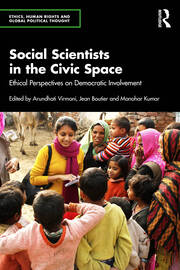
Social Scientists in the Civic Space Ethical Perspectives on Democratic Involvement
List of contributors x Introduction 1 Arundhati Virmani, Jean Boutier, and Manohar Kumar PART I Challenges of the context 9 1 Historians in a world in crisis (1919–1944) 11 Jean Boutier 2 Discovering the genocide of the Rwandan Tutsi: Civic engagement or activism? 25 Stéphane Audoin-Rouzeau 3 The freedom of the foreign scholar?: Writing national histories from afar 38 Arundhati Virmani PART II Interventions in the civic space 55 4 Three forms of expertise in social sciences 57 Irène Théry 5 Citizen economist or economist citizen?: An interview of Pulapre Balakrishnan and Pierre-Cyrille Hautcoeur 68 Arundhati Virmani 6 Experiencing last-mile welfare: Field notes from six districts in India 79 Ashwani Kumar 7 Why so few economists have become public figures 97 Alain Trannoy PART III Involvement in public debates 115 8 Public action and food security in India: Report from a participant-observer 117 Madhura Swaminathan 9 Social sciences, democracy, and social reforms: Insights from Scandinavia and France 137 Yohann Aucante 10 Anti-gender movements in France and Brazil in the 2010s: Populism, anti-intellectualism, and attacks on gender studies 153 Michel Bozon 11 Feminist research engagement and civic space in India 164 B. Rajeshwari PART IV Ethical politics of democracy 179 12 Are experts welcome in democratic societies? 181 Gloria Origgi 13 Data for public journalism and social research: Technological change and the civic space in India 192 Midhat Fatimah, Aasim Khan, and Sarayu Natarajan 14 Defining norms of civility: Disobedience as protest 205 Manohar Kumar PART V Perspectives 219 15 The labour of Sisyphus 221 Ranabir Samaddar Index 231
Biography
Arundhati Virmani, Historian at the Ecole des Hautes Etudes en Sciences Sociales, Marseilles, works on transformations of cultural and political practices from the colonial period to the contemporary moment in India and in Europe.
Jean Boutier, Professor Emeritus of early modern European history at the Ecole des Hautes Etudes en Sciences Sociales, Marseilles, and former Director of the Norbert Elias Centre in Social Sciences (2002–2011), is a specialist of comparative history of social elites.
Manohar Kumar, Assistant Professor in the Department of Social Sciences and Humanities, Indraprastha Institute of Information Technology (IIIT-D) Delhi, India.
‘A fascinating volume on the various forms of interventions by social scientists in the civic space, in India and worldwide. It offers a nuanced understanding of how scholars’ production of knowledge distinguishes them particularly from journalists and social influencers in dealing with the challenges thrown up by social realities.
A much-needed book for our troubled times. A must-read.’
— Thomas Piketty, Economist, Ecole des Hautes Etudes en Sciences Sociales, Paris and Paris School of economics
‘With its insightful epistemic analysis of mutually enriching relationships between social sciences and civic spaces, the volume constitutes a critical tool to combat contemporary forms of enervating anti-intellectualism. It strengthens the social basis and egalitarian thrust of social sciences. Democratic societies cannot do without them’.
—Gopal Guru, Political Scientist, Former Professor at Jawaharlal Nehru University, New Delhi and former editor of Economic and Political Weekly
‘At a time when the legitimacy and relevance of knowledge produced in the academic social sciences have been increasingly questioned by a variety of actors, including the public, it is only appropriate that social scientists find time and space to make their case to the public. The collection of articles in this volume offers a broad range of examples from history, economics and politics, as well as many insightful ways of rethinking the scope and nature of the engagement between academicians/experts and the public. It should be mandatory reading for social science students.’
—Sundar Sarukkai, Philosopher, Barefoot Philosophers
