





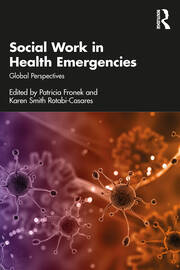
1st Edition
Social Work in Health Emergencies Global Perspectives
Chapter 1: Introducing social work in health emergencies
Patricia Fronek and Karen Smith Rotabi-Casares with Jonathan Dickens
Part I- Regional, historical and social work perspectives
Chapter 2: Regions of the world and the COVID-19 health emergency Patricia Fronek and Karen Smith Rotabi-Casares with Jianqiang Liang, Wanchai Roujanavong, Myung Hun Kim, Sungmin Kim, Yanuar Farida Wismayanti, Gokul Mandayam, Antonio López Peláez, Roberta Di Rosa, Jonathan Dickens, Nicoleta Neamțu, Mădălina Hideg, Claudia Fonseca, Carmen Monico, Renie Rondon-Jackson, Gidraph G.Wairire, Janestic Mwende Twikirize, Dorothee Hölscher, Corlie Giliomee, Taghreed Abu Sarhan, Nadia C. Badran, Tarek Zidan, Sareh Rotabi and Lynne Briggs
Chapter 3: Lessons from pandemic history
Matthew C. Ward
Chapter 4: Human dignity
Donna McAuliffe with Hilary N. Weaver, Sharon E. Moore and Robert Common
Part II– Social work practice, issues and responses
Chapter 5: Hospital social work during the second wave in Canada
Barbara Muskat, Shelley Craig, Deepy Sur and Alexa Kirkland
Chapter 6: Child protection and health emergencies in Botswana
Thabile A. Samboma
Chapter 7: Family violence during the COVID-19 pandemic
Louise Harms, Eliza Crossley, Elyssa Hudson, Connie Kellet and Lauren Kosta
Chapter 8: Families and the COVID-19 pandemic: perspectives from the UK
Gabriela Misca, Janet Walker and Gemma Thornton
Chapter 9: Disability and health emergencies
Tarek Zidan
Chapter 10: Ageism, older people and COVID-19
Malcolm Payne
Chapter 11: Impacts of global pandemics on people on the move
Justin S. Lee and Carmen Monico
Chapter 12: Mental health social work in Hong Kong during the COVID-19 pandemic
Ching-Wen Chang and Marcus Chiu
Chapter 13: Urban homelessness: housing and health equity during health emergencies
Elizabeth Bowen and Nicole Capozziello
Chapter 14: The new social services: organising community during ecosocial health crises
Joel Izlar
Chapter 15: Challenges and innovations in field education in Australia, New Zealand and the United States
Lynne Briggs, Jane Maidment, Kathryn Hay, Kai Medina-Martinez, Renie Rondon-Jackson and Patricia Fronek
Part III– Preparing for the future
Chapter 16: Social innovation as the need of the hour in health emergencies
Gokul Mandayam, Samuel Ochieng, Kelley Bunkers, Siân Long, Yoko Kobayashi and Karen Smith Rotabi-Casares
Chapter 17: Preparing for the next health emergency
Patricia Fronek and Karen Smith Rotabi-Casares
Chapter 18: Yesterday, today and tomorrow
Patricia Fronek and Karen Smith Rotabi-Casares
Part IV: Bonus Chapters
Chapter 19: SARS-CoV-2 in wildlife: Q &A with Alan B. Franklin
Chapter 20: COVID-19: Q &A with Peter C. Doherty
Biography
Patricia Fronek is an Associate Professor in social work, academic and researcher in the School of Health Sciences and Social Work, Griffith University, Australia. Currently, she is the Director of the Bachelor of Social Work Program, a member of Griffith University’s Law Futures Research Centre, and is Special Advisor to Child Identity Protection (CHIP). Social justice, human rights, ethics and professional practice are core to her practice and research over the last forty years. Her work is widely published and highly regarded.
Karen Smith Rotabi-Casares is a Professor in social work with a background in child protection and family support. Her work is international and she has been engaged in child rights and health promotion projects in a number of countries, to include Belize, Guatemala, Bosnia-Herzegovina, Malawi, the United Arab Emirates and Somalia. Focused on child rights, Rotabi-Casares is most interested in prevention with an orientation to the development of programs that engage the community and human service organizations in social change.
