





1st Edition
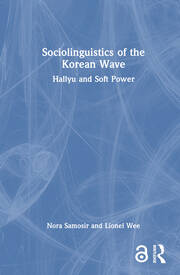
Sociolinguistics of the Korean Wave Hallyu and Soft Power
1. The Korean Wave as a Sociolinguistic Phenomenon 2. Soft Power Beyond the State 3. The Soft Power of Hallyu: The State and the Creative Industries 4. K-Pop: Product and Process 5. K-dramas: Serialising Korean Culture 6. K-films: Korean Culture as Movie Spectacle 7. Beyond the Three Ks: Consuming Korea 8. Towards a Better Understanding of Soft Power
Biography
Nora Samosir is a professional theatre practitioner, having acted in more than 100 stage productions and also in films. Since 2018, she has been part of the duo Wandering Women with Bharatanatyam dancer Dr Nidya Shanthini Manokara creating stage performances as part of their practice-as-research project based on the lives of Draupadi and Mary Magdalene. Her other research strand, combining her undergraduate training in linguistics with her postgraduate interest in the performance of popular culture, is in Hallyu – Korean pop music, serialised dramas and films. Currently at LASALLE College of the Arts, Singapore, she teaches Voice in the BA Acting and BA Musical Theatre programmes of the School of Dance and Theatre.
Lionel Wee is a Provost’s Chair Professor and linguist in the Department of English, Linguistics and Theatre Studies, National University of Singapore. He is interested in language policy (especially in Southeast Asia), the grammar of Singapore English, metaphorical discourse, and general issues in sociolinguistics and pragmatics. He sits on the editorial boards of the Journal of Sociolinguistics, Applied Linguistics, International Journal of the Sociology of Language, Elements: World Englishes and Advances in World Englishes, among others. His recent books include Language, Space and Cultural Play: Theorizing Affect in the Semiotic Landscape (with Robbie Goh), and The Singlish Controversy: Language, Identity and Culture in a Globalizing World.
"Samosir and Wee deploy a sophisticated battery of sociolinguistic tools to delicately dissect key factors behind the world-wide popularity of Hallyu, showing what lends K-wave its unprecedented success as soft power, distinct from hard power, is stern independence of the creative industries from state agendas; a lavish no-strings attached state infrastructural support; and an ambition by all to see the K-wave wash well beyond local shores in the swell of a good story. An indispensable book for understanding the success story that is Hallyu, it is also testament to the indispensability of sociolinguistics in grasping the global world in which we live."
Christopher Stroud, Emeritus Professor of Linguistics, University of the Western Cape, South Africa. Professor of Transnational Multilingualism, Stockholm University, Sweden.
