




1st Edition
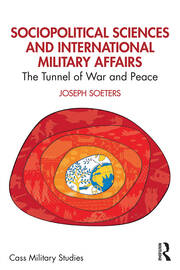
Sociopolitical Sciences and International Military Affairs The Tunnel of War and Peace
Introduction 1. Gabriel Tarde: Interaction, imitation, democracy and innovation 2. Pitirim Sorokin: War and revolution, catastrophes and calamities, international relations, altruism 3. Robert K. Merton: “Theories of the middle range” in the military 4. Howard S. Becker: Professional identification – from labelling to hostilization 5. James C. Scott: State interventions vis-à-vis the weapons of the weak 6. Fatema Mernissi: The world of Islam, religious influences and women in military affairs 7. Robert Axelrod: Strategic handling of (rising) conflicts 8. Saskia Sassen: Global cities at war, expulsion and migration, information technology in the military 9. Elinor Ostrom: Governing the commons in security matters 10. Theda Skocpol: Revolutions, welfare policies and the military 11. Johan Galtung: From direct, structural and cultural violence to peace 12. Randall Collins: Prediction, interaction rituals and micro-violence 13. Zygmunt Bauman: Holocaust, modernity and collateral damage 14. George Ritzer: Globalization, McDonaldization and (ir)rationality in the armed forces 15. Conclusions: From war to peace (eventually)
Biography
Joseph Soeters is a professor emeritus from the Netherlands Defense Academy and Tilburg University, the Netherlands. He has authored or (co-)edited some 15 books on various military topics, including Sociology and Military Studies (2018), Management and Military Studies (2020), and The Routledge Handbook of Research Methods in Military Studies (co-editor, 2014).
‘I enjoyed reading this book. It is a sequel to the earlier Sociology and Military Studies, which had a similar formula that proved very successful. More than that other book, this one is not just about military sociology stricto sensu, but also about the broader field of conflict sociology. The book is a pleasure to read, each time providing an encounter with a well-known sociologist whose writings contain insights that turn out to be surprisingly relevant to this book’s subject. A treasure trove for students about to write a thesis.’
Abram de Swaan, Emeritus Distinguished Research Professor, University of Amsterdam
‘Following Soeters’s volumes on sociology and management in military contexts, this third work expands the analytical lens beyond the armed forces to encompass the broader dynamics of international conflict, revolution and peacebuilding. Soeters illuminates the continued relevance of general social theory to understanding contemporary warfare – from hybrid and cognitive operations to the erosion of democratic structures. This volume cements Soeters’s position as a leading voice in reimagining military sociology as a field deeply informed by the breadth and depth of the social sciences. Through his sustained intellectual endeavour, the field of military sociology has grown conceptually more ambitious and theoretically richer.’
Yagil Levy, Professor, Department of Sociology, Political Science & Communication, Open University of Israel
‘This very timely and original book proposes using theories and ideas of 14 social and political scientists to help us understand why and how violent conflicts and wars erupt, develop and how they can end peacefully. It also analyses the role and functioning of military organizations in these kinds of environments. People interested in making sense of contemporary violent events, such as in Ukraine and Gaza, will find the book particularly interesting and useful, and so will students and scholars in conflicts and military studies.’
Philippe Manigart, Professor Emeritus, Royal Military School, Brussels
