




1st Edition
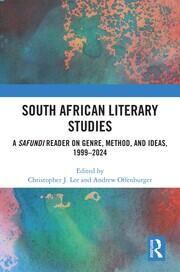
South African Literary Studies A Safundi Reader on Genre, Method, and Ideas, 1999-2024
Introduction
Christopher J. Lee
Section I. Transnational Comparisons
1. Growing Up with Maya Angelou and Sindiwe Magona: A Comparison (2001)
Siphokazi Koyana & Rosemary Gray
2. Oprah's Paton, or South Africa and the Globalization of Suffering (2006)
Rita Barnard
3. Theory and Intertextuality: Reading Zora Neale Hurston and Bessie Head (2008)
Desiree Lewis
4. South Africa, the USA, and the Globalization of Truth and Reconciliation: Itinerant Mourning in Zakes Mda's Cion (2009)
Kerry Bystrom
Section II. South African Literatures
5. Neither History nor Freedom Will Absolve Us: On the Ethical Dimensions of the Poetry of Lesego Rampolokeng (2011)
Khwezi Mkhize
6. Kopano Matlwa’s Coconut and the Dialectics of Race in South Africa: Interrogating Images of Whiteness and Blackness in Black Literature and Culture (2013)
Aretha Phiri
7. Conspicuous Destruction, Aspiration and Motion in the South African Township (2013)
Megan Jones
8. Black music and pan-African solidarity in Keorapetse Kgositsile’s poetry (2017)
Uhuru Portia Phalafala
9. Metamorphosis of Xhosa masculinity in Thando Mgqolozana’s A Man Who is Not a Man (2020)
Nonhlanhla Dlamini
Section III. Interviews
10. An Interview with Chris Abani (2009)
Amanda Aycock
11. An Interview with Mark Behr (2011)
Andrew van der Vlies
12. Reflection, understanding, and empathy: a conversation between Carol-Ann Davids and Patrick Flanery (2017)
Carol-Ann Davids and Patrick Flanery
Section IV. Non-Fiction
13. “In a Country where You couldn’t Make this Shit up”?: Literary Non‐Fiction in South Africa (2012)
Hedley Twidle
14. Non‐Fiction Booms, North and South: A Transatlantic Perspective (2012)
Rob Nixon
15. Writing Spaces: Fiction and Non-Fiction in South Africa (2012)
Stephen Clingman
Section V. White Writing
16. Accounting for Language: Narrative Ethics and Economic Reparations in Antjie Krog's Country of my Skull
Dalgleish Chew
17. Spectacles of Dystopia: Lauren Beukes and the Geopolitics of Digital Space (2015)
Phoenix Alexander
18. A tree full of hillbillies: grotesque humor in Marlene van Niekerk’s Triomf (2020)
Molly Abel Travis
Section VI. Spaces and Environments
19. Properties of Whiteness: (Post)Apartheid Geographies in Zoë Wicomb's Playing in the Light (2011)
Stéphane Robolin
20. Johannesburg Sighted: TJ/Double Negative and the Temporality of the Image/Text (2015)
Stefan Helgesson
21. Coetzee's Stones: Dusklands and the nonhuman witness (2018)
Daniel Williams
Section VII. Questions of World Literature
22. Cold War and Hot Translation (2007)
Monica Popescu
23. The Urge to Nowhere: Wicomb and Cosmopolitanism (2011)
Abdulrazak Gurnah
24. You Are Where You Aren’t: Mark Behr and the Not-Quite-Global Novel (2013)
Jeanne-Marie Jackson
25. “The island is not a story in itself”: apartheid’s world literature (2018)
Ashleigh Harris
Biography
Christopher J. Lee has published eleven books, including Making a World after Empire: The Bandung Moment and Its Political Afterlives (2010, rev. 2nd edition 2019), Unreasonable Histories: Nativism, Multiracial Lives, and the Genealogical Imagination in British Africa (2014), Frantz Fanon: Toward a Revolutionary Humanism (2015), Kwame Anthony Appiah (2021), and Alex La Guma: The Exile Years, 1966-1985 (2024). He is currently the Lead Editor of Safundi.
Andrew Offenburger is Associate Professor of History at Miami University, Oxford, USA. He is author of Frontiers in the Gilded Age: Adventure, Capitalism, and Dispossession from Southern Africa to the U.S.-Mexican Borderlands, 1880-1917 (Yale University Press, 2019) and is co-editor with Patricia Nelson Limerick on the forthcoming Translating Past to Present: Interpreters in the American West and Beyond (University of Nebraska Press). He is the Founding Editor of Safundi.
