




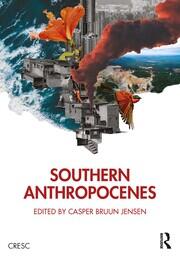
Introduction: Southern Anthropocenes
Casper Bruun Jensen
Part 1. Emergent Interfaces
Introduction: Emergent Interfaces
Marilyn Strathern
1. Welcome to the End of the World: Thinking beyond the Separation of Human and Geological Temporalities
Penelope Harvey
2. Tropical Cargoscapes: Sojourning Putridities in the Afterlives of Medical Necrowaste
Rapti Siriwardane-de Zoysa
3. Diving into the Underwater Anthropocene: Vital Materiality and the Becoming of a Shipwreck
Jakkrit Sangkhamanee
4. Gardens at the Edge of the Falling Sky: Toward an Entropological Pact
Cristóbal Bonelli
Part 2. Problems of Co-Existence
Introduction: Problems of Co-Existence
Mario Blaser
5. Wounded Lands, Resentful Mountains, and Mourning Maize: The Ecological Violence of War and Peace in Latin America
Daniel Ruiz-Serna
6. Anthropo-Scene Relations and the "Human activity" in Zimbabwe’s Forest Reserves
Tafadzwa Mushonga
7. Difference and Disobedience: Inhabiting the Southern Anthropocene
Niranjana R
8. The Plasticene and the Global South
Paul Jobin
Part 3. Livable Worlds
Introduction: Livable Worlds
Elaine Gan
9. To Forego: An Ethics for the Urban Anthropocene
Abdoumaliq Simone
10. Kinship in the Technosphere: From Ishimure Michiko’s Paradise in the Sea of Sorrow to Miyazaki Hayao’s Nausicaä of the Valley of the Wind
Yuki Masami
11. For a World Where Mutual Worlds Fit: Political Ontology in the Anthropocene
Alyne Costa
Part 4. Speculations
Introduction: Speculations (or How to Inhabit the Pluriverse?)
Didier Debaise
12. Decolonial Portals as Pedagogical Practice
Bea Rodriguez-Fransen, Victoria Desimoni and Iveta Silova
13. Anthropocenes Off-Earth
Juan Francisco Salazar
14. How to Construct a Time Machine: The Anthropocene in an Indigo Vat
Steven D. Brown, Marta Gasparin and Martin Quinn
15. Speculation as Method: World-Building and Collective (Un-)Learning for the Anthropocene
Asli Kemiksiz, Atsuro Morita and Émile St-Pierre
Part 5. More-Than-Human Itineraries
Introduction: More-Than-Human Itineraries
Marisol de la Cadena
16. Street Feeding Stray Cats: A Multi-Species Cosmopolitics in Urban Indonesia
Fadjar Ibnu Thufail
17. Migratory Birds, Migratory Lives: A Brackish Contact Zone in Bang Pu, Thailand
Jiraporn Laocharoenwong
18. Artisans of the Plasticene: Polytanks and Plasticities in Urban Ghana
Brenda Chalfin with Alhassan Seidu
19. Reclaiming Country: Australian Aboriginal Walking Trails as Method
Jennifer Eadie and Stephen Muecke
Part 6. Entangled Territories
Introduction: Entangled Territories
Kregg Hetherington
20. Under the Plastic Tarp: Memory and a Southern Anthropocene in California’s Pajaro Valley
Kathleen Cruz Gutierrez
21. Arctic Worlds in Southern Anthropocenes
Olga Ulturgasheva
22. How to Survive Medicine in the Anthropocene?
Gergely Mohácsi
23. After the End of the World: Another Season of War in South Lebanon
Munira Khayyat
Post-script. What Tales Will We Leave the Children of Tomorrow? Story-Trading across Southern Anthropocenes
Casper Bruun Jensen with Isabelle Stengers
Biography
Casper Bruun Jensen is a Professor in the Department of Sociology and Anthropology at Chulalongkorn University in Bangkok. He is the author of Ontologies for Developing Things (2010) and Monitoring Movements in Development Aid with Brit Ross Winthereik (2013) and the editor of Deleuzian Intersections: Science, Technology, Anthropology with Kjetil Rödje (2009) and Infrastructures and Social Complexity with Penny Harvey and Atsuro Morita (2016). His work focuses on climate, environments, infrastructures, and speculative and practical ontologies.
"Since the Anthropocene was proposed, we have known that while the causes are ‘human’ we must be freed from the ‘Human’ to allow for making plural, ways of living and thinking. Southern Anthropocenes does so by creating a plane of consistency for multiplicities. It is an urgently needed collective undertaking."
Déborah Danowski, Professor Emeritus at Pontifical Catholic University of Rio de Janeiro, Brazil
"Written from the archives and territories of a diverse array of ecological situations and struggles, Southern Anthropocenes rekindles our hope in social theory’s ability to attune to the stream of life. This acutely present, yet anticipatory volume functions as a collective composition that explicitly seeks out divergence, showing why and how social theory must recommence the active search for portals and contact zones to worlds beyond the modern.
The 'anthropocene variations' within illuminate portals into regenerative ways of worlding emerging from the multiple souths that inhabit the planet."
Arturo Escobar, author of Designs for the Pluriverse (2018), Pluriversal Politics (2020) and Relationality: An Emergent Politics of Life Beyond the Human (2024, with Michal Osterweil and Kriti Sharma)
"Southern Anthropocenes is the collection of conceptual revisions, perspectival realignments, and theoretical openings that we have all been waiting for! Its authors dismantle the idea of a unitary Anthropocene by taking readers on a rhizomatic journey through strategies of world making and problem solving across the globe, showcasing the myriad modes through which people have exceeded imperial pathways to modernity and humanity, and the innumerable lessons to be absorbed about coping with planetary transformation. By eschewing easy reversals and embracing the idea of pluriversal contact zones, Southern Anthropocenes asks us to reorient both our empirical and analytic gazes to attune ourselves to radical forms of co-existing and relational repair – it is a must read!"
Deborah A. Thomas, R. Jean Brownlee Professor of Anthropology, Director, Center for Experimental Ethnography, University of Pennsylvania, USA
