




1st Edition
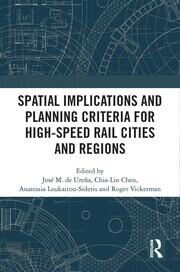
Spatial Implications and Planning Criteria for High-Speed Rail Cities and Regions
Introduction: Spatial short and long-term implications and planning challenges of high-speed rail: A literature review framework
Chia-Lin Chen, Anastasia Loukaitou-Sideris, José M. de Ureña and Roger Vickerman
1. A methodological approach to analyze the territorial appropriation of high-speed rail from interactions between actions and representations of local actors
Valerie Facchinetti-Mannone
2. Has HSR improved territorial cohesion in Spain? An accessibility analysis of the first 25 years: 1990-2015
Andres Monzon, Elena Lopez and Emilio Ortega
3. Short- and long-term population and project implications of high-speed rail for served cities: Analysis of all served Spanish cities and re-evaluation of Chiudad Real and Puertollano
José M. Coronado, José M. de Ureña and José Luis Miralles
4. Measuring the regional economic impacts of high-speed rail using a dynamic SCGE model: The case of China
Zhenhua Chen
5. Regional heterogeneity in Taiwan HSR demand developments: Station accessibility and its effect on usage adoption
Junghwa Kim, Yeun-Touh Li and Jan-Dirk Schmöcker
6. Efficiency of high-speed rail for business and tourism same-day trips: Effects of different transport-related factors
Amparo Moyano, Ana Rivas and Jose M. Coronado
7. Are the reasons for companies to locate around central versus peripheral high-speed rail stations different? The case of Reims central station and Champagne-Ardenne station
Christophe Beckerich, Sylvie Benoit and Marie Delaplace
8. Designing Paris Gare du Nord for pedestrians or for clients? New retail patterns as flow optimization strategies
Nacima Baron
9. Assessing spatial planning strategy in high-speed rail station areas in Spain (1992-2018): towards a sustainable model
Cecilia Ribalaygua and Silvia Perez-Del-Caño
Conclusion
José M. de Ureña, Chia-Lin Chen, Anastasia Loukaitou-Sideris and Roger Vickerman
Biography
José Maria de Ureña is Emeritus Professor of City and Regional Planning, University of Castilla La Mancha. He has served as the Rector of the University of Cantabria and President of the Santander Group of European Universities. He has worked and contacted research at several leading universities across Europe and USA. His research includes planning for riverfront areas, urban regeneration, spatial implications of high-speed rail, design of public spaces, metropolitan multicentric regions, and teaching/learning methods.
Chia-Lin Chen is Lecturer in Urban Planning at Department of Geography and Planning, University of Liverpool. Her main research interests lie in exploring the relationship between transport and territorial dynamism across different spatial scales, seeking potential solutions through the role of design, integrated strategic planning and assessment, and multi-level institutional governance.
Anastasia Loukaitou-Sideris is Distinguished Professor of Urban Planning at the University of California Los Angeles (UCLA) and the Associate Dean of the UCLA Luskin School of Public Affairs. Her interests are in the areas of urban design and transportation. She is the author or editor of nine books and over 100 papers on issues dealing with planning, transportation, and urban design.
Roger Vickerman is Emeritus Professor of European Economics, University of Kent and Visiting Professor, Transport Strategy Centre, Imperial College London. He is the author of 6 books and over 200 papers. He was Editor in Chief, Transport Policy 2010-2016 and is Editor in Chief of Elsevier’s Encyclopaedia of Transportation.
