




1st Edition
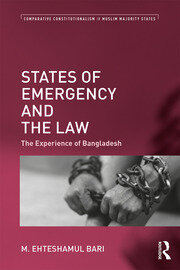
States of Emergency and the Law The Experience of Bangladesh
Contents
Acknowledgments
Table of Cases
Table of Constitutions/Statutes
Table of Legislative Instruments
1 Introduction
2 General Issues Concerning the Powers of Emergency and the Evolution of these Powers in the Indo-Pak-Bangladesh Subcontinent
3 Suspension of the Fundamental Rights and the Exercise of the Power of Preventive Detention during Emergencies in the Indo-Pak-Bangladesh Subcontinent
4 Devising and Developing a Standard Emergency Model
5 The Emergencies Proclaimed in Bangladesh on Five Occasions from 1974 to 2007 and their Justification
6 Impact of the Five Proclamations of Emergency in Bangladesh on the Fundamental Rights of Individuals
7 Preventive Detention Laws in Bangladesh, their Exercise during the Five Proclamations of Emergency and Judicial Response to Such Exercise
8 Conclusion
Biography
Dr M. Ehteshamul Bari is a Lecturer in Law and the Director of the JD Program at Deakin University, Melbourne, Australia. He did his PhD in Law from Macquarie University, Sydney, in 2015 on an International Macquarie University Research Scholarship. Ehteshamul has published research articles on various aspects of constitutional law, human rights law and public international law in quality peer reviewed journals, such as the Oxford University Commonwealth Law Journal, San Diego International Law Journal, Commonwealth Law Bulletin and the Journal of East Asia and International Law.
During the period of intense resistance to colonisation in the Subcontinent, the use of emergency powers was correctly seen as a key method used by colonial authorities to stifle incipient nationalism and independence efforts. Virtually all leaders of decolonisation movements railed against such emergency legislation and vowed to abolish it immediately upon achieving independence. Unfortunately, too many saw the value of maintaining such laws, whether in constitutional or legislative form, to cement and perpetuate their own grip on power. In this book, Dr M. Ehteshamul Bari offers a masterful account of this phenomenon, focusing mainly on Bangladesh, which has had five states of emergency imposed since independence, but also comparing and contrasting the position with other constitutional democracies. Dr Bari provides a clear and compelling analysis of the critical need to maintain the rule of law and fundamental human rights, no matter the security challenges faced by a state. In an increasingly uncertain world, I commend this very important work without reservation to jurists, legislators and policymakers.
Prof David Weisbrot AM FAAL DLitt
Chair, Australian Press Council
Former President of the Australian Law Reform Commission (1999-2009).
A wide-ranging contribution on theory of ‘states of emergency’, in constitutional law and in political practice—with detailed attention to British India, modern India, Pakistan and, particularly, Bangladesh. A ‘standard constitutional model of emergency powers’ is suggested. Dr M. Ehteshamul Bari provides an instructive analysis of how it may be possible to guard against grasping guards.
A/Professor Iain Stewart (Honorary Fellow, Macquarie Law School, Macquarie University)
Dr Bari’s work is a deep exploration of emergency powers and the rights of individuals subject to those powers in Bangladesh’s fragile democratic system. Notably, Bari situates the Bangladeshi law
