




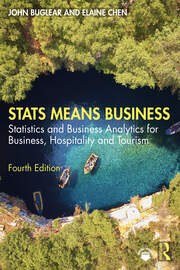
4th Edition
Stats Means Business Statistics and Business Analytics for Business, Hospitality and Tourism
1. Numbers in business: the basics
1.1 Introduction
1.2 How this book is organised
1.3 Taking the first steps
1.3.1 The key terms you need to know
1.3.2 The basic numerical skills you need
1.4 Technological support
1.5 Vignette: how numbers can help get businesses going
1.6 Test yourself questions
2. Presenting data
2.1 Introduction
2.2 Types of data
2.3 Displaying qualitative data
2.3.1 Pictographs
2.3.2 Pie charts
2.3.3 Bar charts
2.4 Displaying quantitative data
2.4.1 Grouped frequency distributions
2.4.2 Histograms
2.4.3 Cumulative frequency graphs
2.4.4 Stem-and-leaf displays
2.4.5 Presenting two quantitative variables
2.4.6 Presenting time series data
2.5 Vignette: taking data presentation further with infographics
2.6 Test yourself questions
3. Summarising values of a single variable
3.1 Introduction
3.2 Measures of location
3.2.1 The mode
3.2.2 The median
3.2.3 The arithmetic mean
3.2.4 Choosing which measure of location to use
3.2.5 Finding measures of location from classified data
3.3 Measures of spread
3.3.1 The range
3.3.2 Quartiles and the semi-interquartile range
3.3.3 The standard deviation
3.3.4 Finding measures of spread from classified data
3.4 Measuring quality and consistency
3.5 Vignette: minding the gender pay gap
3.6 Test yourself questions
4. Summarising bivariate data
4.1 Introduction
4.2 Correlation and regression
4.2.1 Correlation analysis
4.2.2 The coefficient of determination
4.2.3 Simple linear regression analysis
4.3 Summarising data collected over time
4.3.1 Index numbers
4.3.2 Basic time series analysis
4.4 Vignette: a world of statistics
4.5 Test yourself questions
5. Assessing risk
5.1 Introduction
5.2 Measuring probability
5.3 Different types of probabilities
5.4 The rules of probability
5.4.1 The addition rule
5.4.2 The multiplication rule
5.4.3 Bayes’s rule
5.4.4 Applying the rules of probability
5.5 Probability trees
5.6 Vignette: what drives the cost of car insurance?
5.7 Test yourself questions
6. Putting probability to work
6.1 Introduction
6.2 Simple probability distributions
6.3 The binomial distribution
6.4 The Poisson distribution
6.5 Expectation
6.6 Decision trees
6.7 Vignette: decisions, decisions, decisions!
6.8 Test yourself questions
7. Modelling populations
7.1 Introduction
7.2 The normal distribution
7.3 The standard normal distribution
7.3.1 Using the standard normal distribution
7.4 Sampling distributions
7.4.1 Estimating the standard error
7.5 The t distribution
7.6 Choosing the correct model for a sampling distribution
7.7 Vignette: do we perform normally?
7.8 Test yourself questions
8. Statistical decision-making
8.1 Introduction
8.2 Estimation
8.2.1 Determining sample size
8.2.2 Estimating without σ
8.2.3 Estimating with small samples
8.3 Estimating population proportions
8.3.1 Determining sample size
8.4 Hypothesis testing
8.4.1 Hypothesis testing without σ
8.4.2 Hypothesis testing with small samples
8.5 Testing hypotheses about two population means
8.5.1 Large independent samples
8.5.2 Small independent samples
8.5.3 Paired samples
8.6 Testing hypotheses about population proportions
8.7 A hypothesis test for the population median
8.8 Vignette: sampling to solve brewing problems
8.9 Test yourself questions
9. Statistical decision-making with bivariate data
9.1 Introduction
9.2 Contingency tests
9.3 Testing and estimating with quantitative bivariate data
9.3.1 Testing correlation coefficients
9.3.2 Testing regression models
9.3.3 Constructing interval predictions
9.3.4 When simple linear models won’t do the job
9.4 Vignette: going away green
9.5 Test yourself questions
10. The role of data in business analytics
10.1 Introduction
10.2 The importance of data
10.2.1 Types of data sources
10.2.2 Types of data
10.2.3 The data lifecycle
10.2.4 Data quality
10.3 Types of business analytics
10.3.1 Descriptive analytics
10.3.2 Predictive analytics
10.3.3 Prescriptive analytics
10.4 Business analytics process
10.5 Data ethics
10.5.1 Data ethic frameworks
10.5.2 Data visualisation tools
10.6 Technologies and tools in business analytics
10.6.1 Statistical software
10.6.2 Data visualisation tools
10.6.3 Programming languages
10.6.4 Artificial intelligence, machine learning and data mining
10.7 Vignette: using business analytics to improve customers' experience
10.8 Test yourself questions
11. Descriptive analytics
11.1 Introduction
11.2 Data analysis warm-up
11.2.1 Characteristics of a good question
11.2.2 Types of questions to ask of the data
11.3 Data cleaning
11.4 Data summarisation
11.4.1 Cross-tabulation
11.4.2 Pivot tables
11.5 Data visualisation techniques
11.5.1 Categorical data
11.5.2 Numerical data
11.5.3 Advanced graphical techniques
11.6 Effective data visualisation
11.6.1 Mental models
11.6.2 Gestalt principles of design
11.7 Vignette: real-time interative dashboard at Hilton
11.8 Test yourself questions
12. Predictive analytics
12.1 Introduction
12.2 The concept of machine learning
12.3 Introduction to Python programming
12.4 Predictive modelling
12.4.1 Regression models
12.4.2 Decision trees
12.4.3 Clustering
12.4.4 Association rule mining
12.4.5 Sentiment analysis
12.4.6 Machine learning models with poor performance
12.5 Vignette: Amazon recommender system
12.6 Test yourself questions
13. Prescriptive analytics
13.1 Introduction
13.2 Optimisation models
13.2.1 Linear programming
13.2.2 Integer programming
13.3 Simulation models
13.3.1 Monte Carlo simulation
13.3.2 Probability distributions
13.3.3 Monte Carlo simulation process
13.4 Decision theory
13.4.1 Decision-making under risk
13.4.2 Decision-making under uncertainty
13.5 Vignette: maximising profitability – Marriott’s revenue optimisation system
13.6 Test yourself questions
14. Managing statistical research
14.1 Introduction
14.2 Secondary data
14.3 Primary data
14.3.1 Selecting your sample
14.3.2 Choosing the size of your sample
14.3.3 Methods of collecting primary data
14.4 Presenting your analysis
14.5 Vignette: when The Literary Digest had to eat its words
Appendix 1
Appendix 2
Biography
John Buglear teaches statistics at Nottingham Business School, Nottingham Trent University.
Elaine Chen teaches business analytics at Nottingham Business School, Nottingham Trent University.
‘This book is a valuable resource for managers. It is written in a clear and easily understood style and can be used as a program for both in-work and pre-work manager development. The clear exposition of each chapter’s content and learning outcomes are supported by practical exercises that enable reader application of the techniques outlined.’
Professor Conrad Lashley, Professor Emeritus, NHL Stenden International Hospitality Management School, The Netherlands
‘This book is written in an engaging style with clear explanations articulated in a very accessible way. The use of examples and interesting case studies ("vignettes") brings home the importance and relevance of statistics and quantitative techniques for students of business and management. The book will help to allay the fears that students can sometimes have towards statistics.’
Dr Dean Garratt, Senior Teaching Fellow, Aston Business School, UK
‘Statistics is often viewed as a minefield experience for students. What Stats Means Business does is to allow all students, irrespective of past experience, to plot a successful route through that quagmire. It provides clear and concise explanations coupled with relevant worked examples thereby providing a step-by-step process that creates relevance to the student. I would recommend this text to all students wishing to gain a strong grounding in the statistical needs of both business and research.’
Dr Karl T. Knox, International Business, Marketing and Tourism, University of Bedfordshire, UK
