





1st Edition
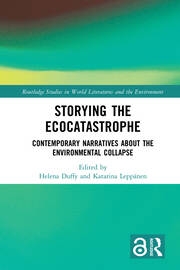
Storying the Ecocatastrophe Contemporary Narratives about the Environmental Collapse
Introduction
Storying the Ecocatastrophe: From Doom-and-Gloom Scenarios to Messages of Hope
Helena Duffy
Chapter 1
Daily Life and Global Crisis: Human Experience and Narrative Fiction in the Age of the Anthropocene
Markku Lehtimäki
Chapter 2
Feelings of Hope and Helplessness in Knut Faldbakken’s and Maja Lunde’s Climate Change Novels: An Econarratological Reading
Georgiana Bozîntan
Chapter 3
Narrating the Economic Value of Nature in the Anthropocene
Xin Liu
Chapter 4
Building a New World on the Ruins of Helsinki: Critical Utopia in Annika Luther’s The City of the Homeless
Katarina Leppänen
Chapter 5
Extreme Climate and the Anthropocentric Conception of Agency in Cinematic Ocean Planets
Faeze Rezaii
Chapter 6
The Radiant Future vs The End of History: The (Eco)politics of Antoine Volodine’s Radiant Terminus
Helena Duffy
Chapter 7
The Nuclear Disaster as Metaphor for the Impending Ecocatastrophe in Anticipatory Fiction from Luxembourg
Sébastian Thiltges
Chapter 8
Speculating on Ecological Futures: Narratives of Hope and Multispecies Justice in Contemporary Ecofiction
Elizabeth Tavella
Chapter 9
Nature and Masculinity in Barbara Kingsolver’s Prodigal Summer: Writing an Ethical Shift in Environmental Perception
Chloé Bour-Lang
Chapter 10 Backward Looking is Necessarily Organic: Female Artists Revisit Traumatic Pasts and Reimagine Present and Future Alliances Katarzyna Bojarska
Chapter 11
‘Ruined and Wrecked!’: Annie Proulx Confronts the Ecocatastrophe
Hannah Jocelyn
Chapter 12
Congolese Anthropocenes, Wounds of Extraction, Arts of Resistance: Transcultural Materialism in Fiston Mujila’s Tram 83 and Sammy Baloji’s The Beautiful Time
Spring Ulmer
Afterword
One Must Cultivate One’s Own Garden
Helena Duffy
Biography
Helena Duffy (MSt Oxon, PhD Oxford Brookes) is Professor of French at the University of Wrocław, Poland. Her research on the cultural representations of World War II and the Holocaust has resulted in the publication of the monographs World War II in Andreï Makine’s Historiographic Metafiction (2018) and The Holocaust in French Postmodern Fiction (2022). She has edited issues of French Forum, Journal of Holocaust Research, and Eastern European Holocaust Studies, and, with Avril Tynan, has co-edited a collection of essays, Trauma, Ethics, Hermeneutics (2024).
Katarina Leppänen is Professor of Intellectual History and the Head of the Department of Literature, Intellectual History and Religion at the University Gothenburg, Sweden. Her ongoing project deals with the importance of literary transnational, international, and regional exchanges in the Nordic and Baltic countries in the early twentieth century. Titled ‘Cosmopolitan and Vernacular Dynamics in World Literature,’ the project is funded by the Swedish Foundation for Humanities and Social Sciences.
