





1st Edition
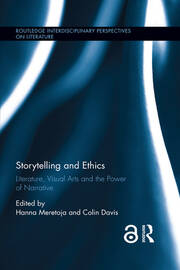
Storytelling and Ethics Literature, Visual Arts and the Power of Narrative
Chapter 1: Introduction: Intersections of Storytelling and Ethics
Hanna Meretoja and Colin Davis
Part I: The ethical potential and limits of narrative
Chapter 2: Truth, Ethics, Fiction: Responding to Plato’s Challenge
Colin Davis
Chapter 3: Is there an Ethics to Story-Telling?
Mieke Bal
Chapter 4: Forms of Ordering: Trauma, Narrative and Ethics
Robert Eaglestone
Chapter 5: The Decline of Narrative and the Rise of the Archive
Ernst van Alphen
Chapter 6: The Story of the "Anthropos": Writing Humans and Other Primates in Contemporary Fiction
Danielle Sands
Chapter 7: From Appropriation to Dialogic Exploration: A Non-Subsumptive Model of Storytelling
Hanna Meretoja
Part II: Narrative temporalities: imagining an other life
Chapter 8: Alexander Kluge’s "Saturday in Utopia": Making Time for Other Lives with German Critical Theory and Heliotropic Narration
Leslie A. Adelson
Chapter 9: Melancholy and the Narration of Transnational Trauma in W.G. Sebald and Teju Cole
Kaisa Kaakinen
Chapter 10: Memory as Imagination in Elina Hirvonen’s When I Forgot
Riitta Jytilä
Chapter 11: Popular Representation of East Germany: Whose History is it?
Molly Andrews
Chapter 12: Realities in the Making: The Ethics of Fabulation in Observational Documentary Cinema
Ilona Hongisto
Part III: Narrative engagements with violence and trauma
Chapter 13: The Empathetic Listener and the Ethics of Storytelling
Aleida Assmann
Chapter 14: Theatre, Ethics and Restitution: What is Theatre Good For?
Anna Reading
Chapter 15: Towards an Intercultural Aesthetics: Shaping the Memory of Political Violence and Historical Trauma in Eija-Liisa Ahtila’s Artwork Where is Where?
Mia Hannula
Chapter 16: Reading Terror: Imagining Violent Acts through the Rational or Narrative Sublime
Cassandra Falke
Chapter 17: War & Storytelling After 9/11: A Photojournalist’s Perspective
Louie Palu
Part IV: Concluding reflections
Chapter 18: Narrative in Dark Times
Andreea Deciu Ritivoi
Biography
Colin Davis is Professor of French at Royal Holloway, University of London, UK.
Hanna Meretoja is Professor of Comparative Literature and Director of SELMA: Centre for the Study of Storytelling, Experientiality and Memory at the University of Turku, Finland.
"Thinking of the empathetic listener as secondary witness (Assmann), the assemblage of restitution (Reading), the heterogeneous temporalities of the present (Kaakinen) and subsumptive vs. non-subsumptive storytelling (Meretoja) as well as many other tools for thought and analysis introduced and developed in this volume, it becomes clear that Storytelling and Ethics has indeed brought together new vocabularies for articulating how literary and other artistic narratives open new possibilities of thought and experiences."
- Anne Rüggemeier, Diegesis
