




1st Edition
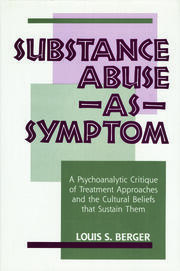
Substance Abuse as Symptom A Psychoanalytic Critique of Treatment Approaches and the Cultural Beliefs That Sustain Them
Biography
Louis S. Berger's rich professional life spans the fields of electrical engineering (B.S.), physics (M.S.), music (M.M.), and clinical psychology (Ph.D.). Formerly on the faculty of the Department of Psychiatry and Behavioral Sciences, University of Louisville School of Medicine, he is now Staff Psychologist at Southwest Research Institute, San Antonio, Texas. Dr. Berger is the author of Introductory Statistics: A New Approach for the Behavioral Sciences (1981) and Psychoanalytic Theory and Clinical Relevance: What Makes a Theory Consequential for Practice? (Analytic Press, 1985).
"Berger offers a thoughtful and impressive review that critiques an exclusively biological model of substance abuse and persuasively presents the evidence that psychological suffering and distress are at the root of addictive disorders. . . . Berger provides an empathic and sophisticated appreciation of addicts' vulnerabilities, avoids simplistic or reductionistic explanations of addiction, and considers the modifications of theory and practice that are required to access, understand, and modify the psychological and developmental facts that predispose individuals to addictive disorders."
- Edward Khantzian, M.D., Contemporary Psychology
"Dr. Berger has persuasively questioned the legitimacy of the traditional vision of addiction. He has dared to challenge the shibboleths of the 'medical model' and its derivative applications to the addicted person. Instead of a biological orientation that mandates a disease process, he offers a sociopsychoanalytic perspective which places the person and not the therapeutic system at the center of our concerns. One need not embrace all of Berger's social, political, and epistemological assumptions to appreciate the justifiable optimism in his message. This book is a worthwhile adventure for any health professional who wishes an alternative to the bankruptcy of contemporary approaches to the problem of addiction."
- J. Gordon Maguire, M.D., Training and Supervising Analyst, Chicago Institute for Psychoanalysis
"Substance Abuse as Symptom is a courageous and radical undertaking. Louis Berger tackles one of the most salient problems in our society, looking deeply into the history and assumptions that define it. Approaching substance abuse from a sociocultural perspective and as a psychotherapeutic problem, he demonstrates, in both respects, the fertility of sophisticated psychoanalytic thinking. His social criticisms are trenchant, his social proposals appropriately tentative and modest, his therapeutic suggestions theoretically grounded and practically applicable. This is a praiseworthy book."
- Alvin G. Burstein, Ph.D., Professor and Director of the Clinical Psychology Program, University of Tennessee
