



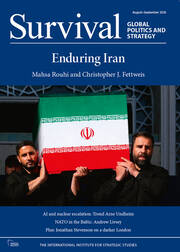
1st Edition
Survival: August-September 2026
Survival 68.4 (August–September 2026), pp. 1–200
Nuclear Command Without Control: AI and the Problem of Escalation Opacity, by Trond Arne Undheim
From Star Wars to Golden Dome: The Past, Present and Future of Missile Defence, by Frank A. Rose
Humans Versus Slaughterbots, by Rafal Rohozinski
Europe’s Strategic-imagination Deficit, by Riccardo Alcaro
Noteworthy: IISS Shangri-La Dialogue 2026
The Politics of Endurance: Iran and the Limits of Coercion, by Mahsa Rouhi
The Iran Threat in Perspective, by Christopher J. Fettweis
Ensuring NATO Sea Control in the Baltic, by Andrew Livsey
South Korea Needs a Taiwan Principle, by Taehwa Hong
Resilience by Design: How Kazakhstan and Uzbekistan Survive amid Great-power Rivalry, by Johan Engvall and Mikael Weissmann
Weaponised Connectivity: How Geo-economic Pressure Operates Below the Radar, by Ramkishen Rajan
The Friends of Zac Brettler, by Jonathan Stevenson
Book Reviews
Russia and Eurasia, by Marlene Laruelle
Cyber Security and Emerging Technologies, by Melissa K. Griffith
Deterrence, Arms Control and Nuclear History, by Matthew Jones
America’s Quarter-millennium, by Dana H. Allin
Biography
The International Institute for Strategic Studies (IISS), a registered charity with offices in Washington, London, Manama, Singapore and Berlin, is the world’s leading authority on political–military conflict. It is the primary independent source of accurate, objective information on international strategic issues. Publications include The Military Balance, an annual reference work on each nation’s defence capabilities; The Armed Conflict Survey, an annual review of the world’s active conflicts; Survival, a bimonthly journal on international affairs; Strategic Comments, an online analysis of topical issues in international affairs; and the Adelphi series of books on issues of international security.
‘In a world of complex security challenges the need for serious, thoughtful analysis is greater than ever. Survival’s combination of elegant writing and rigorous scholarship from the world’s top experts makes it essential reading for both practitioners and academics.’
Professor Sir Lawrence Freedman, War Studies King's College London
