




1st Edition
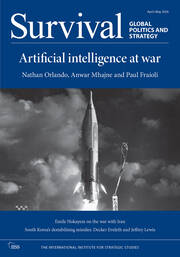
Survival: April–May 2026
Survival 68.2 (April–May 2026), pp. 1–216
Salvific User Error: A Classical Take on AI and Nuclear Deterrence, by Nathan Orlando
Regulating Military AI: Gaza and Beyond, by Anwar Mhajne
The War Against Iran, by Emile Hokayem
The Carney Doctrine: Is Canada Breaking with America?, by Seva Gunitsky
Japan’s Relations with China: A Clash of Core Interests, by Robert Ward
The Second Death of Arms Control, by Andrew C. Winner
Noteworthy: The Final Arbiter?
Running in Circles: How Europe’s Quest for Autonomy Creates New Dependencies, by Riccardo Alcaro
Taking Leave: NATO’s Command Structure Amid US Disengagement, by John R. Deni and Mark Webber
South Korea’s Ominous Missile Deployments, by Decker Eveleth and Jeffrey Lewis
The Radicals’ Dilemma After Civil Wars: Evidence from Syria, by Raphaël Lefèvre
China, Greece and Port Geopolitics, by John T. Psaropoulos
Critical Minerals and Geo-economic Peril, by Chris Clague
Book Reviews
United States, by David C. Unger
Middle East, by Ray Takeyh
Environment and Resources, by Shiloh Fetzek
Strange Days: AI and the Next Industrial Revolution, by Paul Fraioli
Biography
The International Institute for Strategic Studies (IISS), a registered charity with offices in Washington, London, Manama, Singapore and Berlin, is the world’s leading authority on political–military conflict. It is the primary independent source of accurate, objective information on international strategic issues. Publications include The Military Balance, an annual reference work on each nation’s defence capabilities; The Armed Conflict Survey, an annual review of the world’s active conflicts; Survival, a bimonthly journal on international affairs; Strategic Comments, an online analysis of topical issues in international affairs; and the Adelphi series of books on issues of international security.
‘In a world of complex security challenges the need for serious, thoughtful analysis is greater than ever. Survival’s combination of elegant writing and rigorous scholarship from the world’s top experts makes it essential reading for both practitioners and academics.’
Professor Sir Lawrence Freedman, War Studies King's College London
