




1st Edition
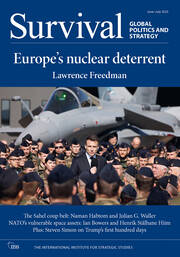
Survival: June–July 2025
Survival 67.3 (June–July 2025), pp. 1–216
Europe’s Nuclear Deterrent: The Here and Now, by Lawrence Freedman
Managing Escalation: America’s Two-peer Nuclear Problem, by Anna Péczeli
Arms Control Under Nuclear Asymmetry, by Inwook Kim and Seung Joon Paik
Trump’s Century of Days, by Steven Simon
DOGE and the Future of US Foreign Aid, by Heidi Jane M. Smith
The Sahel Coup Belt and the Return of Praetorianism, by Naman Habtom and Julian G. Waller
Noteworthy: Trump’s Deportations and the Courts
Knock-on Risks to NATO’s Space-based War-fighting Capabilities, by Ian Bowers and Henrik Stålhane Hiim
Europe Needs Less Defence Cooperation, by Bence Nemeth
Bimodal Deterrence: Sea Denial and Sea Control in US Maritime Strategy, by James J. Wirtz
The Future of Economic Warfare, by Mariya Grinberg
Sanctions: Failure by Other Means, by Chris Clague
Book Reviews
Deterrence, Arms Control and Nuclear History, by Matthew Jones
Latin America, by Ryan C. Berg
Europe, by Erik Jones
Politics and International Relations, by Chester A. Crocker
The Managerial Revolution Rebooted, by Joe Pesmen
Biography
The International Institute for Strategic Studies (IISS), a registered charity with offices in Washington, London, Manama, Singapore and Berlin, is the world’s leading authority on political–military conflict. It is the primary independent source of accurate, objective information on international strategic issues. Publications include The Military Balance, an annual reference work on each nation’s defence capabilities; The Armed Conflict Survey, an annual review of the world’s active conflicts; Survival, a bimonthly journal on international affairs; Strategic Comments, an online analysis of topical issues in international affairs; and the Adelphi series of books on issues of international security.
‘In a world of complex security challenges the need for serious, thoughtful analysis is greater than ever. Survival’s combination of elegant writing and rigorous scholarship from the world’s top experts makes it essential reading for both practitioners and academics.’
Professor Sir Lawrence Freedman, War Studies King's College London
