





1st Edition
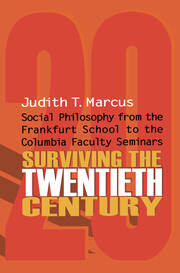
Surviving the Twentieth Century Social Philosophy from the Frankfurt School to the Columbia Faculty Seminars
By Judith T. Marcus
Copyright 1999
444 Pages
by
Routledge
444 Pages
by
Routledge
436 Pages
by
Routledge
Also available as eBook on:
Surviving the Twentieth Century celebrates the achievements of the renowned sociologist Joseph Maier. A superb teacher and respected scholar of formidable scope, Maier's work encompassed a variety of disciplines, including sociology, philosophy, and political science. He is well known for his comparative research on Latin America as well as Jewish law and tradition. As Judith Marcus observes,... Read more
Part 1: Biographical: Interviews and Personal Notes; 1: From Leipzig to America: The Story of a Friendship; 2: Joseph Maier: A Personal Reminiscence; 3: Meeting Moses Finley and His Old Friend, Joseph Maier; 4: The Fury of Historical Redemptionism: An Interview with Joseph B. Maier, September 30, 1982; 5: Joseph B. Maier: Reflections on His Career and Contribution to the University Seminars at Columbia; Part 2: Social Science Inquiries into the Human Condition; 6: Nationality, Citizenship, and Sociocultural Community; 7: Politics and Problems of Collective Identity in France and Germany: A Comparative Analysis; 8: Social Integration, National Identity, and German Unification; 9: Ethnicity, Nationality, and Nationalism in Early Austrian-Hungarian Social Science; 10: On Peter Blau’s Interpretation of Simmel; 11: Education and Society in Germany; 12: The Scientific Status of Social Research: The Political Context of Contemporary Sociology; 13: The “Ideal-Typical” Presentation of the Jewish Intellectual in Thomas Mann’s Work; 14: What Tocqueville Might Say About Our NEA; 15: Twenty-Five Year History of the Club of Rome; 16: Victimhood and Empowerment: Madonna’s “Like a Prayer”; 17: The Notion of the Personal and the Cult of Personality: Reflections on Television in Nigeria and North America; 18: Frederick J. Teggart on “Entering California”: Self-Reflections on Migrations, Religion, and the Humanistic Sciences; 19: Existenzialistische Aufklärung. Anklänge der Leipziger Schule an die Kritische Theorie; Part 3: On Philosophy, Aesthetics, and Intellectual Linkages; 20: Philosophy, Literature, and Intellectual Responsibility; 21: Semantics and Street-Bred Irreverence; 22: My German Visitors; 23: Religionsphilosophie und Religionskritik bei Ernst Bloch; 24: Benedictus de Spinoza; 25: Sich Nicht zur Unzeit Begegnen—Ein Feature; 26: L’autodestruction de la Raison La place de la ‘Dialektik der Aufklärung’ dans l’évolution de la Théorie critique; 27: Ansätze zu einer Erinnerungskultur als Praxis des Wahrnehmens und Wahrgebens; Part 4: Jewish History, Art, and Community; 28: Individual and Institutional Survival Strategies: Berlin 1936–1942; 29: Torah as Movable Territory; 30: The Jews of Barcelona in the Time of R. Nissim b. Reuben Gerondi: 1340—1380; 31: Das Buch: Zeichen für Frömmigkeit und Gelehrsamkeit in der Jüdischen Kunst; 32: Zwischen den Mächten. Gottesherrschaft und Weltpolitik in der Gedankenwelt des mittelalterlichen Judentums; Part V: Lauditatio; 33: A Message; 34: Joseph Maier: The Seminar Chairman; 35: Greetings!; About The Contributors
Biography
Judith T. Marcus
