




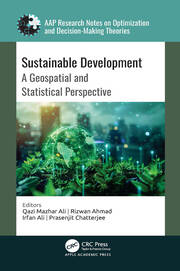
1st Edition
Sustainable Development A Geospatial and Statistical Perspective
1. Multicriteria Optimization Modeling for the Sustainable Development Goals of Nigeria: Mission 2030
U. M. Modibbo, M. Mijinyawa, M. A. Ahmed, and O. U. Cynthia
2. Simulating the Impacts of Land Use Transformations on Flood Potential Using a Distributed Hydrological Model, in the Palani Hills, South India
Haris Hasan Khan, Arina Khan, Aswathy N. S., Asif Iqubal
3. Decadal Land Use/Land Cover Change Detection Using Remote Sensing & GIS Technique in Karnataka, South India
Qazi Zeeshan Ahmad Jalali, Mohammed Irshad, Rizwan Ahmad, P. S. Roy, and Mohammed Zaid Qamar
4. Spatiotemporal Mapping of Air Pollutants in Delhi During the Haze Period
Farheen Mahtab, Tanzeel Khatoon, and Anand Sharma
5. Mapping the Groundwater Table in an Alluvial Aquifer Using Digital Elevation Model, GIS, and Geostatistics
Haris Hasan Khan, Arina Khan, Ghazala Siraj, and Taqveem Ali Khan
6. Spatial Regression and Temporal Analyses Using GIS: A Case Study of India
Qazi Mazhar Ali, Mohammad Sajid, Rizwan Ahmad, Ateebur Rehman Sherwani, and Akram Javed
7. A Spatially Explicit Framework for Computing the QoL Index for People in the Cauvery River Basin
Abhishek Gupta, Ramesh Krishnamurthy, Mohammad Sajid, and Mohammed Zaid Qamar
8. A Remote Sensing and GIS-Based Two-Decadal Spatiotemporal Analysis of the Delhi Region Due to Variability in Climate
Waiza Khalid, Samreen Fatima, Anand Sharma, and Mohammad Sajid
9. Measurements of Precipitation over the Antarctic Region: Ground-Based and Satellite Measurements
Stephy Abraham, Alia Yusuf, Rounaq Goenka, and Ziaur Rehman Ansari
10. Spatiotemporal Monitoring of Land Surface Temperature for Assessing Heat-Related Health Risks
Zeba Khanam, Mansoor Alam Siddiqui, Uzma Ajmal, Saleha Jamal, and S.K. Ajim Ali
11. A Multi-Attribute Optimization Modeling of Socioeconomic Issues of Sustainable Development Goals of India: Mission 2030
Jahangir Chauhan, Aqsa Anjum, U. M. Modibbo, and Irfan Ali
12. Energy Supply Cost Sustainability: A Case Study of Educational Institution
Aqsa Anjum and Jahangir Chauhan
13. Exploring Market Hierarchy and Infrastructural Facilities for Sustainable Rural Development in India: A Geographical Perspective
Mohammad Muqeet Khan, Tanveer Asif, and Niraj Prakash Joshi
14. Quantification of Potential Evapotranspiration from Pindari-Kafni Glacier Valleys in Kumaun Central Himalayas
Pankaj Chauhan, Sameer Tiwari, and Kalachand Sain
Biography
Qazi Mazhar Ali, DPhil (Oxon), is the former Dean of the Faculty of Science and Professor of Statistics at the Department of Statistics & Operations Research, Aligarh Muslim University, India. He earned his doctorate degree from the University of Oxford in 1993. He has been designated as the primary point of contact for the United Nations Global Geospatial Information Management (UNGGIM), and he is actively engaged in the Sustainable Development Goals 2030 through a statistical data network. He has published his work in digital image analysis, classification (remotely sensed images), epidemiology, and bioinformatics in the UK and Germany. He contributed in popularizing PCbased computer education in the 1980s and continues to advance it still.
Rizwan Ahmad, PhD, is a faculty member at the Interdisciplinary Department of Remote Sensing & GIS Applications, Aligarh Muslim University, India. His research interests include Earth observation, geospatial technology applications, and GIS data integration. He has a doctorate in geoscience and has vast research and teaching experience in India and abroad. He has worked with prestigious institutes such as the IIRS-ISRO (Indian Institute of Remote Sensing–Indian Space Research Organisation; Forest Survey of India (MoEF & CC, Govt. of India), Dehradun; and Eritrea Institute of Technology (EIT), Asmara, Eritrea (North East Africa).
Irfan Ali, MPhil, PhD, is a Senior Assistant Professor of Statistics and Operations Research at Aligarh Muslim University, India. He was recently recognized by ScholarGPS, one of the world-renowned scholar agencies, for his contributions to the mathematical optimization and environment statistics fields. He has published many research articles as well as several books, including the textbook, Optimization with LINGO-18: Problems and Applications. His research interests include applied statistics, mathematical optimization, fuzzy logic and optimization, multi-objective optimization, supply chain management, UN Sustainable Development Goals, and renewable energy production modeling. He has completed several grant projects and also serves as associate editor and editorial board member for several journals.
Prasenjit Chatterjee, PhD, is Dean (Research and Consultancy) at the MCKV Institute of Engineering, West Bengal, India. A prolific author and editor, he is the editor of several book series and has published many research papers and books on intelligent decision-making, supply chain management, optimization techniques, sustainability modeling. disruptive technologies, intelligent computing, etc. Dr. Chatterjee is one of the developers of two multiple-criteria decision-making methods: Measurement of Alternatives and Ranking according to COmpromise Solution (MARCOS) and Ranking of Alternatives through Functional mapping of criterion sub-intervals into a Single Interval (RAFSI). He has received numerous awards for his work.
