




1st Edition
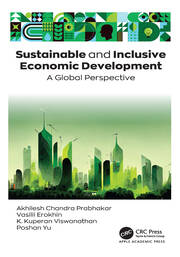
Sustainable and Inclusive Economic Development A Global Perspective
Foreword by Mohamed Mustafa bin Ishak
Foreword by Ora Renagi OL
Preface
1. Introduction to Sustainable and Inclusive Economic Development
2.The Current Economic Scenarios
3. Agricultural Systems, Agrarian Crisis, and Sustainable Agriculture
4. Hunger, Poverty, Unemployment, Inequality, Inflation, Public Debt, and Sustainable Development
5. Historical Evolution of Developmental Theories
6. International Trade Theory and Sustainable Development
7. Human Resource, Climate Change, and Sustainable Development
8.Technological Choice, Underdevelopment, and Sustainable Development
9. Public Debt Sovereign Crisis and Capitalist Development Model
10. Harmony in Motion: Green Energy, Environment, and Sustainable Development
11. Sustainability and Inclusiveness with Achieving Self-Reliance Industrialization
Index
Biography
Akhilesh Chandra Prabhakar, PhD, is an economist with over two decades of international academic and research experience across Asia, Africa, and the Pacific. He has held professorial roles in India, Malaysia, South Korea, Papua New Guinea, and Ethiopia, and has served as Director of the Global South Social Networks and Editor-in-Chief of the International Journal of Asian Social Sciences. His research focuses on sustainable development, industrial economics, and global economic transformation.
Vasilii Erokhin, PhD, is Associate Professor at Harbin Engineering University, China, and a researcher at its Center for Russian and Ukrainian Studies and Arctic Blue Economy Research Center. He has authored more than 190 publications on international trade, globalization, sustainable development, and food security, with a focus on emerging and transition economies. An active journal editor and board member, he has received honors and was recognized by Publons as a top peer reviewer.
K. Kuperan Viswanathan, PhD, is Professor of Resource Economics and Management at Universiti Utara Malaysia, where he leads the Financial Analysis and Policy Competency Center. With over 35 years of experience, he has worked extensively in resource economics, policy, and development research. He has held senior roles with organizations including WorldFish and the FAO and contributed to global initiatives such as fisheries co-management.
Poshan (Sam) Yu is an academic and finance professional teaching at the University of Victoria Program at Soochow University, China. He has held visiting and external professorships across Asia and Europe and serves in editorial roles for several international journals. He has published articles, book chapters, and edited volumes. In addition to academia, he is an entrepreneur and venture capitalist collaborating with global partners.
“Provide[s] a comprehensive overview of the fundamentals of economic development, from the theoretical assumptions of their underpinning principles through to approaches to overcoming obstacles to economic development, and globalization and its impact on global trade and economic development. . . . Case studies provide concrete real-life examples that facilitate the grasp of abstract theories and concepts and go a long way toward enlivening classroom discussions. . . . Will prove to be a much sought-after textbook in institutions of higher learning . . . ”
—From the Foreword by Prof. Dato’ Seri Dr. Mohamed Mustafa bin Ishak, Former Vice-Chancellor, Universiti Utara Malaysia
“Explore[s] the theme of economic development in the era of instability by studying how the basic concepts and theories of economic development and growth could be adapted to the “new normal.” This book particular focus is also on the new challenges to sustainable development brought by the growth of global environmental and public health problems, such as climate change, deterioration of air, water, land, and other resources, reduction of biodiversity, and loss of many natural ecosystems. . . . The book describes contemporary issues of economic development in a systemic manner, making the narrative analytical and comprehensive so that it may easily be accessible to the broad public audience, including honors and postgraduate students, as well as used in competitive examinations . . . Appropriate for government officials, policymakers, and businesses in many countries.”
—From the Foreword by Dr. Ora Renagi OL, Vice Chancellor, University of Technology, LAE, Papua New Guinea
