





1st Edition
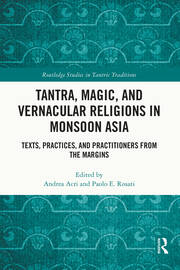
Tantra, Magic, and Vernacular Religions in Monsoon Asia Texts, Practices, and Practitioners from the Margins
Acknowledgement; Introduction, Andrea Acri; 1. More Pre-Tantric Sources of Tantrism: Skulls and Skull-Cups, Ronald M. Davidson; 2. Charnel Ground Items, Śmāśānikas, and the Question of the Magical Substratum of the Early Tantras, Aleksandra Wenta and Andrea Acri; 3. Shamans and Bhūta Tāntrikas: A Shared Genealogy? Michael Slouber; 4. Female Gaṇeśa or Independent Deity? Tracing the Background of the Elephant-faced Goddess in Mediaeval Śaiva Tantric Traditions, Chiara Policardi; 5. Crossing the Boundaries of Sex, Blood, and Magic in the Tantric Cult of Kāmākhyā, Paolo E. Rosati; 6. ‘Let us Now Invoke the Three Celestial Lights of Fire, Sun and Moon into Ourselves’: Magic or Everyday Practice? Revising Existentiality for an Emic Understanding of Śrīvidyā, Monika Hirmer; 7. Narrative Folklore of Khyāḥ from Tantra to Popular Beliefs: Supernatural Experiences at the Margins among Newar Communities in the Kathmandu Valley, Fabio Armand; 8. Magical Tantra in Bengal, Bali, and Java: From Piśāca Tāntrikas to Balians and Dukuns, June McDaniel; 9. Tantrism and the Weretiger Lore of Burma, Thailand, and Cambodia, Francesco Brighenti
Biography
Andrea Acri is tenured Assistant Professor in Tantric Studies at the École Pratique des Hautes Études (EPHE, PSL University) in Paris, France. His publications include the monograph Dharma Pātañjala (2011), as well as various edited volumes, including Esoteric Buddhism in Mediaeval Maritime Asia (2016). His main research and teaching interests are Śaiva and Buddhist Tantric traditions, Indian philosophy, Yoga studies, Sanskrit and Old Javanese philology, and the comparative religious history of South and Southeast Asia from the premodern to the contemporary period, with special emphasis on connected histories and intra-Asian maritime transfers.
Paolo E. Rosati received his PhD in Asian and African Studies from ‘Sapienza’ University of Rome, Italy. He has published a double special issue on Tantra for Religions of South Asia (14/1–2) in 2020, and several contributions on the yoni cult at Kāmākhyā. His current research focuses on magic, memory, and cultural identity in postcolonial Tantric contexts.
The contributors provide nuanced insights into Tantra’s practices and beliefs in Monsoon Asia through meticulous analyses of texts, fieldwork, and historical contexts. This volume significantly contributes to Tantric studies by adopting a chronological approach, from the medieval Indic period to the present, covering several geographic areas and drawing on fields including anthropology, religious studies, history, and philology. [... The book] is a valuable resource for scholars and students studying religion. It will appeal to those interested in the psychology of religion, South Asian religions, Hinduism, Buddhism, and Southeast Asian religions. -- Vineet Gairola, Indian Institute of Technology, Hyderabad, India, Asian Affairs 54.3
